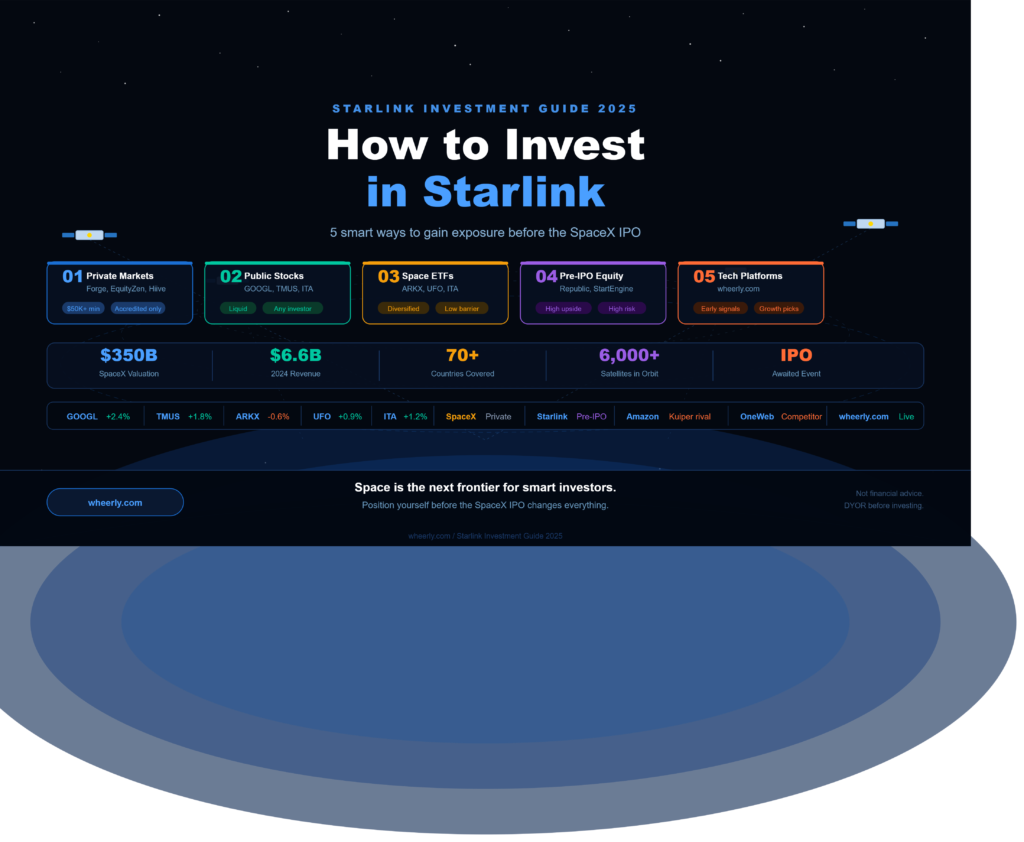
Starlink investment has become one of the most searched financial topics of 2025. SpaceX’s satellite internet service now covers over 70 countries, serves millions of subscribers, and is disrupting the global broadband industry at speed. Investors who missed the early internet wave are paying close attention. The challenge is simple: SpaceX remains private. You cannot buy Starlink stock directly on any exchange today. But there are real, proven ways to gain exposure. Platforms like Wheerly help investors identify high-growth tech opportunities before they go mainstream. This guide covers exactly how to position yourself now.
Table of Contents
- Why Starlink Attracts Serious Investor Attention
- Can You Buy Starlink Stock Directly?
- Invest Through SpaceX on Private Markets
- Buy Starlink-Adjacent Public Stocks
- ETFs with Indirect Starlink Exposure
- Pre-IPO Platforms and Equity Crowdfunding
- Key Risks Every Investor Must Know
- Final Verdict: Is Starlink Worth Your Money?
Why Starlink Attracts Serious Investor Attention
Starlink is not a startup idea. It is an operational, revenue-generating business with a defensible moat. The service generated an estimated $6.6 billion in revenue in 2024, up sharply from prior years. Its low-earth orbit satellite constellation gives it a structural advantage over traditional internet providers. Rural broadband, maritime connectivity, in-flight Wi-Fi, and military contracts are all active revenue streams. The addressable market runs into the trillions of dollars. No competitor has matched its scale or pricing yet. This is exactly the kind of business that attracts institutional and retail investors alike, and why the question of how to invest keeps growing louder every quarter.
Can You Buy Starlink Stock Directly?
No. Starlink is a division of SpaceX, which is privately held. There is no Starlink ticker symbol on the NYSE or NASDAQ. Elon Musk has discussed a potential IPO but has not committed to any timeline. SpaceX’s valuation crossed $350 billion in late 2024, making it one of the most valuable private companies in history. That valuation makes a direct retail purchase impossible through standard brokerage accounts. This does not mean the opportunity is closed. It means you need to use alternative access points, some of which are available to everyday investors and others that require accredited investor status.
Invest Through SpaceX on Private Markets
The closest you can get to owning Starlink directly is buying SpaceX equity on private secondary markets. Platforms such as Forge Global, EquityZen, and Hiive facilitate trades of pre-IPO shares in companies like SpaceX. Sellers are typically early employees or early-stage investors looking for liquidity. Buyers gain real equity ownership before any public listing. The minimum investment is often high, ranging from $50,000 to $100,000 or more. Most platforms require accredited investor status, meaning an annual income above $200,000 or a net worth exceeding $1 million. According to Investopedia, private market platforms have made pre-IPO investing more accessible than ever, though risks remain significant compared to public markets.
Buy Starlink-Adjacent Public Stocks
If private markets are out of reach, public equities offer a practical alternative. Several publicly traded companies have direct financial ties to Starlink’s growth.
Google (Alphabet)
Alphabet invested approximately $900 million in SpaceX as part of a 2015 funding round. While that stake has likely evolved, Alphabet maintains a strategic relationship with SpaceX infrastructure. Buying GOOGL gives you indirect exposure.
T-Mobile US
T-Mobile signed a partnership with SpaceX to deliver direct satellite-to-cell connectivity in dead zones across the United States. This partnership is live and expanding. TMUS is a clean, liquid way to bet on Starlink’s terrestrial integration.
Viasat and Hughes Network Systems
These legacy satellite internet companies face direct competitive pressure from Starlink. Shorting them is one contrarian play, though it carries its own risks.
ETFs with Indirect Starlink Exposure
Exchange-traded funds focused on space and satellite sectors hold companies that supply, compete with, or partner with SpaceX. These funds provide diversified exposure with standard brokerage access.
ARK Space Exploration ETF (ARKX)
ARKX holds companies across orbital infrastructure, satellite technology, and deep space logistics. Its portfolio shifts regularly, so review current holdings before buying.
Procure Space ETF (UFO)
UFO tracks the S-Network Space Index and holds satellite operators, manufacturers, and launch service providers. It is a focused space play with moderate liquidity.
iShares U.S. Aerospace and Defense ETF (ITA)
ITA includes defense contractors with government satellite contracts. Several holdings overlap with SpaceX supplier networks.
Pre-IPO Platforms and Equity Crowdfunding
Beyond private secondary markets, equity crowdfunding platforms occasionally offer access to SpaceX-related ventures. Startups building on Starlink’s infrastructure, ground station operators, and satellite component manufacturers have raised capital through platforms like Republic and StartEngine. These investments carry higher risk and lower liquidity than public stocks, but they offer early-stage upside. Always read the offering documents thoroughly. Understand dilution risk, lock-up periods, and exit timelines before committing capital to any pre-IPO deal.
Key Risks Every Investor Must Know
Starlink investment carries real risks worth taking seriously. SpaceX may delay its IPO indefinitely. Private market shares are illiquid and hard to sell quickly. ETF exposure is indirect and subject to broad market moves. Regulatory risk is real: satellite spectrum disputes and FCC licensing are ongoing battles. Competition from Amazon’s Kuiper, OneWeb, and government-backed programs in China and Europe is accelerating. Diversify your space exposure rather than concentrating in any single position.
Final Verdict: Is Starlink Worth Your Money?
The opportunity is genuine. Starlink is a cash-generating business in a massive, underserved global market. The IPO question is the only real blocker for retail investors. Until that happens, private market platforms, adjacent public stocks, and focused ETFs are your best tools. Start small. Research every vehicle carefully. Position for a multi-year holding period. The space economy is not a short-term trade. It is a structural shift in how the world connects, and Starlink sits at the center of it.

