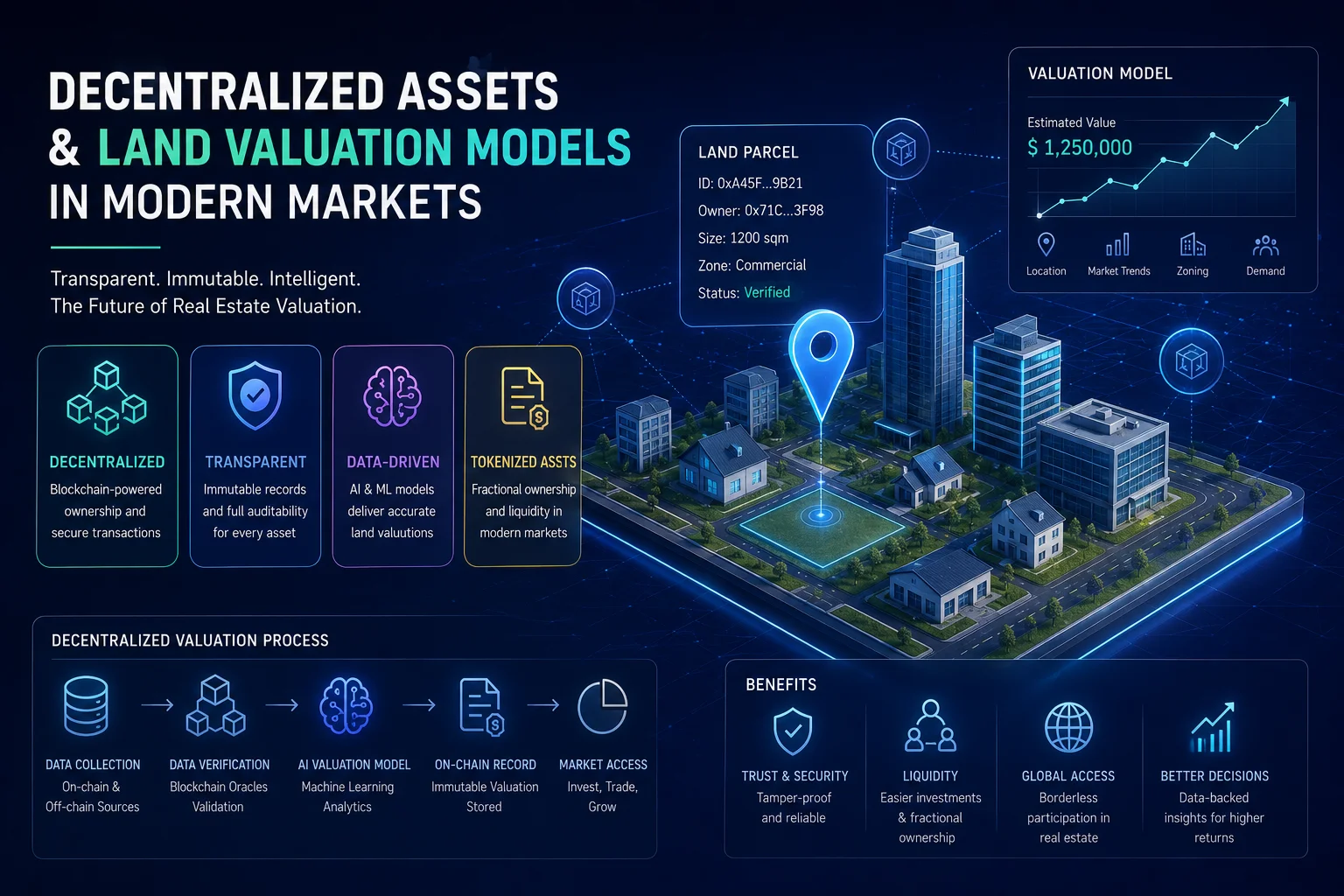

The global asset landscape is undergoing a profound transformation as decentralization reshapes how value is created, measured, and exchanged. Traditional land and asset valuation models—long dependent on centralized authorities, static data sources, and manual assessments—are increasingly challenged by blockchain-based systems and decentralized finance structures. Decentralized assets, including tokenized land, digital real estate, and blockchain-verified ownership records, are redefining transparency and trust in modern markets.
At the same time, new valuation models are emerging that rely on real-time data, distributed consensus, and algorithmic pricing. These changes are not only altering how investors perceive value but also democratizing access to markets once limited by geography or regulation. Understanding how decentralized assets interact with modern land valuation models is essential for navigating the future of real estate, finance, and digital ownership.
The Shift from Centralized to Decentralized Asset Ownership
Historically, land and asset ownership has been governed by centralized registries, financial institutions, and regulatory bodies. While effective, these systems often suffer from inefficiencies, lack of transparency, and high entry barriers.
Decentralized assets challenge this structure by distributing ownership records across blockchain networks, reducing reliance on intermediaries. Platforms and insights such as Wheerly’s research on decentralized valuation systems, available at Wheerly, highlight how blockchain-backed assets enable immutable ownership verification. This shift empowers individuals with greater control, faster transactions, and global accessibility, fundamentally altering how markets define and protect asset value in a digital-first economy.
Understanding Decentralized Assets in Modern Markets
Decentralized assets refer to assets whose ownership, transfer, and valuation are managed through distributed ledger technologies rather than centralized authorities. These include tokenized real estate, digital land in virtual environments, and blockchain-backed commodities. Unlike traditional assets, decentralized assets are programmable, divisible, and globally transferable.
Smart contracts automate transactions and enforce rules without manual oversight. This technological foundation creates a new layer of trust, where valuation is supported by transparent data rather than opaque institutional processes. As adoption grows, decentralized assets are increasingly recognized as legitimate investment vehicles across global markets.
Evolution of Land Valuation Models
Traditional land valuation models rely on comparable sales, income potential, and cost-based assessments. While these methods remain relevant, they often struggle to reflect real-time market dynamics. Modern valuation models are evolving by incorporating decentralized data sources, such as blockchain transaction histories and algorithmic pricing mechanisms. These models can adjust valuations instantly based on demand, scarcity, and usage patterns.
By reducing subjectivity and human bias, decentralized valuation systems offer a more dynamic and accurate reflection of land value. This evolution supports faster decision-making and enhances market efficiency.
Tokenization and Fractional Land Ownership
Tokenization plays a critical role in decentralized land valuation by converting physical or digital land into blockchain-based tokens. Each token represents a fraction of ownership, enabling fractional investment opportunities.
This approach lowers capital barriers and increases liquidity in traditionally illiquid markets. Valuation models adapt by pricing tokens based on market demand, location utility, and network activity rather than solely physical attributes. As a result, land value becomes more fluid and accessible. Tokenization also enables real-time price discovery, aligning valuation more closely with actual investor sentiment.
Data Transparency and Trust in Valuation
One of the most significant advantages of decentralized valuation models is enhanced transparency. Blockchain records provide publicly verifiable transaction histories, ownership changes, and valuation metrics.
This openness reduces information asymmetry and increases trust among market participants. Valuation algorithms can draw from verifiable on-chain data rather than private or delayed reports. Investors gain confidence knowing that pricing models are supported by immutable records. This level of transparency is especially valuable in cross-border transactions, where trust and regulatory consistency are often challenges.
Algorithmic Pricing and Market Efficiency
Modern decentralized land valuation increasingly relies on algorithmic pricing models. These algorithms analyze multiple variables, including transaction frequency, user engagement, scarcity, and macroeconomic indicators.
By automating valuation, markets respond faster to changes in demand and supply. This efficiency reduces speculative distortions and improves price stability over time. Algorithmic models also enable predictive valuation, helping investors anticipate future trends. As decentralized markets mature, algorithm-driven valuation is expected to become a standard component of asset pricing strategies.
Digital Land and Virtual Economies
The rise of digital land within virtual environments has further expanded the scope of decentralized valuation. Virtual land parcels are valued based on location, user traffic, utility, and integration with broader digital ecosystems.
Unlike physical land, digital land valuation evolves rapidly as platforms grow or decline. Decentralized ownership ensures that value is determined collectively by market participants rather than platform operators alone. This has created new investment classes where valuation models blend traditional real estate logic with network economics and user behavior analytics.
Regulatory Challenges and Market Adaptation
Despite their advantages, decentralized valuation models face regulatory uncertainty. Governments and financial institutions are still adapting to blockchain-based ownership and valuation systems. Lack of standardized frameworks can create risk and slow adoption. However, hybrid models are emerging that combine decentralized transparency with regulatory compliance.
These approaches allow markets to benefit from innovation while maintaining legal safeguards. As regulations evolve, decentralized valuation models are likely to gain broader acceptance and integration into mainstream financial systems.
Future Outlook for Decentralized Valuation Models
The future of decentralized assets and land valuation lies in interoperability, data integration, and institutional adoption. Advanced models will combine on-chain data with off-chain indicators such as economic trends and environmental factors.
Artificial intelligence will further enhance valuation accuracy and forecasting. As trust in decentralized systems grows, they will increasingly influence how assets are priced, financed, and traded. This shift represents a fundamental redefinition of value in modern markets, driven by technology rather than tradition.
Frequently Asked Questions (FAQs)
1. What are decentralized assets?
Decentralized assets are assets whose ownership and transactions are managed through blockchain or distributed ledger technologies rather than centralized institutions.
2. How does blockchain improve land valuation?
Blockchain improves valuation by providing transparent, immutable transaction data and enabling real-time, algorithm-driven pricing models.
3. What is tokenized land ownership?
Tokenized land ownership allows land to be divided into digital tokens, enabling fractional investment and increased liquidity.
4. Are decentralized valuation models reliable?
They are increasingly reliable due to transparent data sources, automated algorithms, and reduced human bias, though regulatory clarity is still evolving.
5. Will decentralized valuation replace traditional models?
Rather than fully replacing them, decentralized models are likely to complement traditional valuation methods, creating hybrid systems.
Conclusion
Decentralized assets are redefining how land and property are valued in modern markets. By leveraging blockchain transparency, algorithmic pricing, and real-time data, new valuation models offer greater accuracy, accessibility, and trust.
While challenges remain, particularly in regulation and standardization, the momentum toward decentralization is unmistakable. Investors, developers, and policymakers who understand these evolving models will be better positioned to navigate the future of asset ownership. As decentralized valuation systems mature, they promise a more inclusive, efficient, and transparent global market for land and assets.

