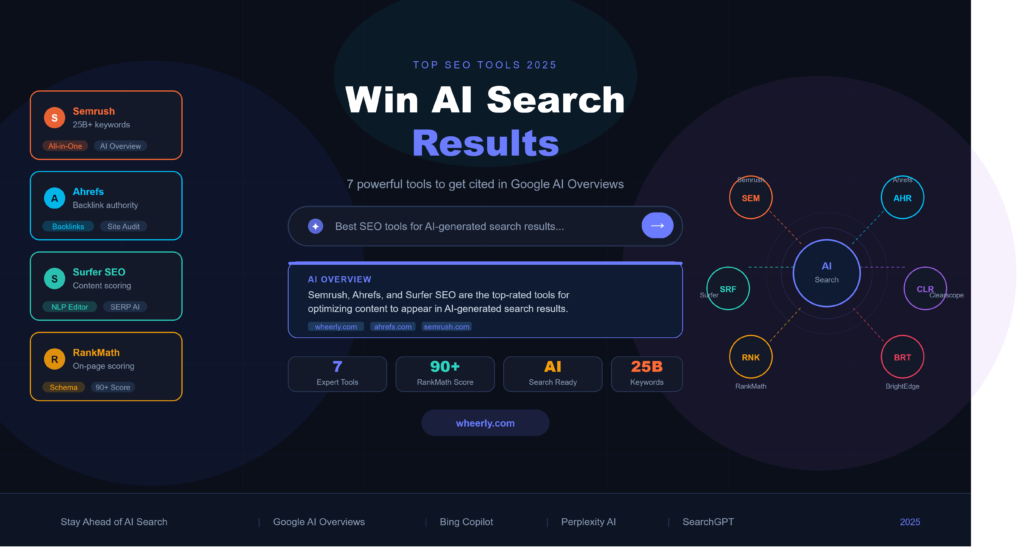
SEO tools are no longer optional for marketers chasing visibility in AI-generated search results. The game has shifted. Google’s Search Generative Experience, Bing’s Copilot integration, and Perplexity AI now answer user queries directly. Your content must be built to win these placements, not just traditional blue links. Platforms like Wheerly are already helping brands adapt their SEO strategy to the AI-first search environment. This guide breaks down seven tools you need right now.
Table of Contents
- Why AI Search Changes Everything for SEO
- Semrush: The All-in-One Powerhouse
- Surfer SEO: Content Optimization at Scale
- Ahrefs: Authority and Backlink Mastery
- Clearscope: Winning AI Overviews with Relevance
- RankMath: On-Page Perfection
- BrightEdge: Enterprise AI Search Intelligence
- Perplexity AI Pro: Research Like the Engine Itself
- How to Choose the Right Tool for Your Stack
Why AI Search Changes Everything for SEO
Traditional SEO focused on ranking position one. AI search changes that entirely. Google’s AI Overviews now appear above organic results, summarizing content from multiple sources. If your page is not cited there, you are invisible to a growing share of users. The click-through rate on organic results below an AI Overview drops sharply. This is not a future problem. It is happening now, and most brands are unprepared. The right SEO tools help you identify where AI pulls answers, optimize for citation, and track your performance inside these new placements.
Semrush: The All-in-One Powerhouse
Semrush remains the most complete SEO platform available. Its keyword research database covers over 25 billion keywords. But its newer AI features are what make it relevant in 2025. The AI Writing Assistant inside Semrush generates content briefs tuned for featured snippets and AI Overviews. The Position Tracking tool now includes an AI Overview tracker, showing whether your domain appears in generative results. For competitive analysis, this level of detail is unmatched. Semrush also integrates with Google Search Console, giving you a combined view of organic and AI-driven traffic sources.
Key Features for AI Search
Semrush’s Keyword Magic Tool filters for question-based queries, which are the backbone of AI-generated answers. Its On-Page SEO Checker flags content gaps that prevent inclusion in AI Overviews. If you run one tool only, this is it.
Surfer SEO: Content Optimization at Scale
Surfer SEO built its reputation on content scoring. Its real-time content editor scores your copy against top-ranking pages as you write. More recently, Surfer added an AI-driven outline builder that structures articles specifically for featured snippet and AI Overview capture. The SERP Analyzer identifies what AI results are pulling from, including schema markup and content depth. Surfer works best when paired with a strong keyword research tool. Its content audit feature is excellent for refreshing existing pages that have dropped out of AI citations.
Ahrefs: Authority and Backlink Mastery
Ahrefs is the gold standard for backlink analysis. In an AI search world, authority signals still carry weight. AI Overviews heavily favor content from sites with strong domain ratings. Ahrefs shows you exactly where your authority gaps lie. Its Content Explorer surfaces high-performing pages in your niche that AI frequently cites. You can reverse-engineer their structure and link profiles. According to Ahrefs research, pages ranking in AI Overviews tend to have significantly higher referring domain counts than those that do not. Ahrefs gives you the data to close that gap.
Site Audit for AI Readiness
Ahrefs’ Site Audit tool crawls your site for technical issues. Clean technical SEO is a prerequisite for AI Overview inclusion. Broken links, slow load times, and missing schema all reduce your chances of being cited.
Clearscope: Winning AI Overviews with Relevance
Clearscope focuses on content relevance scoring. Its grading system ensures your content covers the full semantic field of a topic. AI models like Google’s SGE reward comprehensive, well-structured content that answers multiple related questions. Clearscope helps you identify every subtopic your article must address to compete. Its integration with Google Docs makes it practical for editorial teams. Content teams at major publications use Clearscope to maintain topical authority across entire content clusters, which directly supports AI Overview citations.
RankMath: On-Page Perfection
RankMath is the sharpest WordPress SEO plugin available. Its scoring system targets 100 points across title optimization, meta descriptions, content structure, and schema markup. Rich schema is critical for AI search. AI engines parse structured data to extract facts, product details, FAQs, and reviews. RankMath’s built-in schema generator produces Article, FAQ, HowTo, and Product schema without writing a line of code. Its AI-powered suggestions now include recommendations specifically aimed at AI Overview visibility. For WordPress publishers, RankMath is non-negotiable.
BrightEdge: Enterprise AI Search Intelligence
BrightEdge targets enterprise teams managing hundreds or thousands of pages. Its Data Cube tracks AI Overview appearances across massive keyword sets. The platform’s Generative Parser feature analyzes which content types Google’s AI favors in specific industries. BrightEdge also provides competitive benchmarking inside AI results, showing exactly where competitors appear and where you do not. For large brands with complex site architectures, BrightEdge provides a level of AI search visibility reporting that smaller tools cannot match.
Perplexity AI Pro: Research Like the Engine Itself
Using Perplexity AI as an SEO research tool gives you direct insight into how AI search engines think. Type your target keyword into Perplexity and study which sources it cites. These are your true competitors for AI-generated placements. Perplexity Pro allows unlimited searches and access to its most powerful model. Use it to audit your content against what AI currently favors. This qualitative insight complements the quantitative data from tools like Semrush and Ahrefs. It is a simple habit that pays dividends.
How to Choose the Right Tool for Your Stack
Not every team needs seven tools. Small teams should start with Semrush or Ahrefs for research, RankMath for on-page optimization, and Surfer for content quality. Mid-size teams benefit from adding Clearscope to strengthen topical authority. Enterprise teams running large content operations should evaluate BrightEdge for its AI tracking depth. Every team should use Perplexity as a free research layer. The common thread is simple: optimize for depth, structure, and authority. AI search rewards clarity. Build content that answers completely, structures logically, and earns links from trusted sources. Do that consistently and your presence in AI-generated results will grow.

