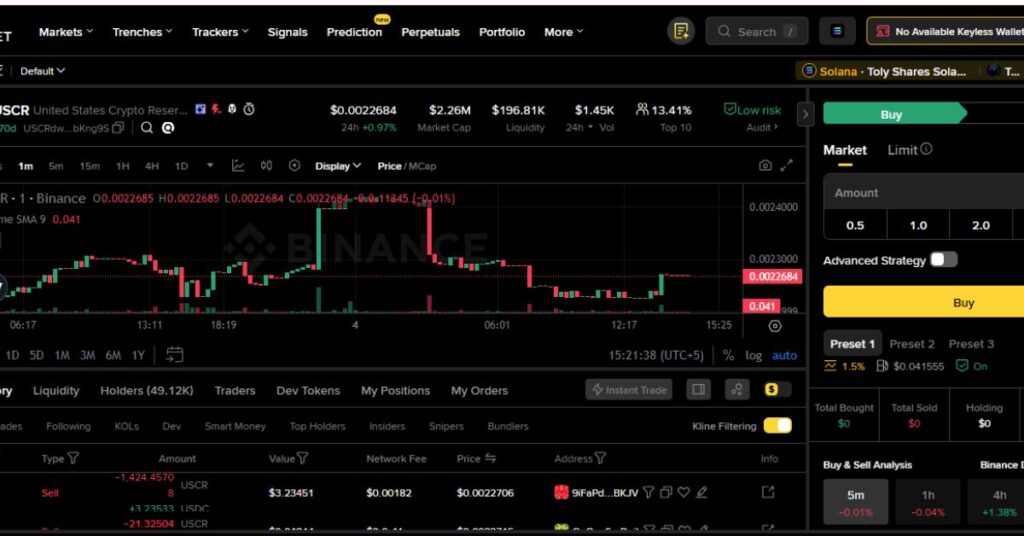
Why Comparison Matters More Than a Standalone Price Check
at the uscr crypto price on its own tells you very little. Context from similar tokens is what actually reveals whether USCR is behaving normally for its category or standing out for the wrong reasons.
This comLooking parison places USCR alongside other Solana-based memecoins, including some far larger names, to show where it genuinely fits within the current market. The goal isn’t to rank tokens by size but to explain what the size gap actually means for risk and behavior.
A Quick Refresher on What USCR Is
USCR, short for United States Crypto Reserve, launched in October 2025 on the Solana blockchain. It describes itself as a community-led token tied to a publicly viewable on-chain reserve of American-built crypto assets, with holders able to vote on portfolio decisions.
It carries an explicit disclaimer that it has no affiliation with the U.S. government, despite branding that leans heavily on that association. It’s currently priced around a fraction of a cent, with a market cap in the low single-digit millions.
The Solana Memecoin Landscape in 2026
Solana has become the dominant home for memecoin trading, largely because of its low fees and fast transaction speeds. The combined Solana meme coin market sits in the billions of dollars, spread across dozens of active tokens with wildly different sizes and trajectories.
USCR sits at the very small end of that spectrum. Understanding where it falls next to more established names helps frame what its price movements actually mean.
[Suggested outbound link: to an overview of how Solana’s transaction speed and fees support meme coin trading]
USCR vs Larger Solana Memecoins: Side-by-Side
| Token | Approximate Market Cap | Notable Trait | Trading Volume Level |
| USCR | Roughly $2 million | Government-adjacent branding, no actual affiliation | Extremely low, often under $2,000 daily |
| BONK | Roughly $350 million | Long-running, 350+ ecosystem integrations | High, consistent daily activity |
| TRUMP | Multi-billion at peak, lower currently | Political branding, extreme early volatility | High |
| Popcat | Peaked around $1 billion | Pure meme, no utility claims | High, listed on major exchanges |
| FARTCOIN | Peaked above $1 billion | Started as a joke, gained serious traction | High |
The gap here isn’t small. USCR’s market cap is a tiny fraction of even mid-sized memecoins like BONK, let alone the billion-dollar names that dominate headlines. That size difference directly explains much of the volatility discussed below.
Why Market Cap Size Changes Everything
Liquidity Depth
Larger tokens like BONK maintain consistent daily trading volume in the tens of millions of dollars, spread across many holders and exchanges. USCR’s daily volume often sits below $2,000, meaning a single moderately sized trade can move its price far more than an equivalent trade would move a larger token.
This isn’t a minor technical detail. It’s the core reason USCR’s percentage swings look so much sharper than what you’d see on an established memecoin chart.
Holder Distribution
Bigger, more established tokens tend to have thousands or millions of holders, spreading out both risk and price influence. USCR’s holder base is comparatively small, which means individual large wallets can have outsized influence over short-term price direction.
Exchange Access
Tokens like Popcat and BONK maintain listings on major centralized exchanges, giving them broader access to buyers and sellers. USCR trades primarily through decentralized exchanges on Solana, which limits its accessible trading pool compared to tokens with wider exchange support.
Branding Comparison: Political and National Themes
USCR isn’t alone in leaning on political branding. The TRUMP memecoin, launched around the same general period, built massive early momentum specifically through political association, reaching an all-time high above $70 before settling into a much lower, more stable trading range.
The difference is scale and staying power. TRUMP maintained enough liquidity and exchange support to remain one of the more actively traded political-themed tokens, while USCR’s early surge faded into thin, low-volume trading. Both illustrate how political branding can drive rapid early attention, but sustained trading activity depends on far more than a catchy name.
Volatility Comparison
USCR has fallen roughly 96% from its all-time high, a decline steep even by memecoin standards. For comparison, established tokens like BONK have experienced significant drawdowns too, but their larger, more distributed holder base and consistent trading volume have helped them avoid the kind of near-total evaporation of activity USCR has seen.
According to Nasdaq’s coverage of institutional memecoin interest, even speculative tokens can attract meaningful capital when backed by strong distribution and ecosystem integrations, a pattern seen with BONK’s corporate treasury adoption in 2025. USCR has not seen anything comparable in terms of institutional or large-scale adoption.
What Sets USCR Apart From Pure Joke Coins
To be fair to the project, USCR isn’t structured identically to tokens built purely around a meme image or joke, like Popcat or FARTCOIN in their earliest days. It claims a publicly viewable on-chain wallet holding other cryptocurrencies, giving it a slightly more structured concept than a pure speculation play.
Whether that structure translates into meaningfully different price behavior is unclear given current data. Its price still moves primarily on thin liquidity and sentiment, the same forces driving most memecoins regardless of their underlying concept.
A Realistic Way to Frame USCR’s Position
USCR sits closer to the thousands of smaller, lower-profile tokens created on Solana daily than to the handful of memecoins that break into mainstream awareness and billion-dollar valuations. That’s not necessarily a permanent state, since token trajectories can shift, but it accurately describes where things stand now.
Anyone comparing the uscr crypto price against a token like BONK or TRUMP should recognize they’re comparing across very different liquidity tiers, not just different price points.
Practical Takeaways From the Comparison
If you’re evaluating USCR against larger memecoins, weigh liquidity and holder distribution as heavily as price trend. A stable-looking chart on a token with almost no trading volume carries far less signal than the same chart pattern on a highly liquid, widely held token.
Watching whether USCR’s daily volume grows meaningfully over time would be one of the clearer signs of genuine, broadening interest rather than short-term speculative spikes.
FAQs
Is USCR similar to BONK or other major Solana memecoins?
Not in scale. USCR’s market cap sits around $2 million, while BONK’s is roughly $350 million, meaning USCR has far less liquidity and holder distribution than more established Solana tokens.
How does USCR’s price volatility compare to other memecoins?
USCR has fallen about 96% from its all-time high, a steeper and more sustained decline than many larger memecoins have experienced. Its extremely low trading volume amplifies price swings more than what’s typical for bigger, more liquid tokens.
Is USCR the only memecoin using political or government branding?
No, tokens like TRUMP have also used political branding to drive early attention and trading volume. USCR’s early surge was similarly sharp but has not sustained the same level of trading activity over time.
Does USCR have any actual government backing like its name suggests?
No, USCR is explicitly not affiliated with, endorsed by, or connected to the United States government or any government entity. This is stated clearly on major tracking platforms and by the project itself.
Why do some memecoins like BONK stay more stable than USCR?
Larger, more established tokens typically maintain broader holder distribution, higher trading volume, and wider exchange access, all of which reduce the price impact of any single trade. USCR’s small size means it lacks these stabilizing factors.
Should I compare USCR’s price directly to bigger tokens like FARTCOIN or Popcat?
Direct price comparisons aren’t especially useful given the massive difference in market cap and liquidity. Comparing volume, holder trends, and overall market structure gives a more accurate picture than price alone.
Could USCR eventually reach the size of larger Solana memecoins?
It’s possible in theory, but nothing in its current trading data suggests that trajectory. Larger memecoins typically grow through sustained volume increases, broader exchange listings, and expanding holder bases, none of which USCR currently shows signs of at scale.
Final Verdict
Comparing the uscr crypto price against larger Solana memecoins makes one thing clear: size and liquidity explain far more about token behavior than branding or concept alone. USCR’s thin trading volume and small holder base put it in a very different risk category than established names like BONK or TRUMP, regardless of how similar the underlying speculative appeal might look on the surface.
If you’re weighing USCR against bigger tokens, treat market cap and daily volume as your primary comparison points, not price charts alone. Right now, USCR remains a small, thinly traded token still working to prove it can sustain meaningful, lasting interest.


Pingback: Is the USCR Crypto Price Undervalued Right Now?