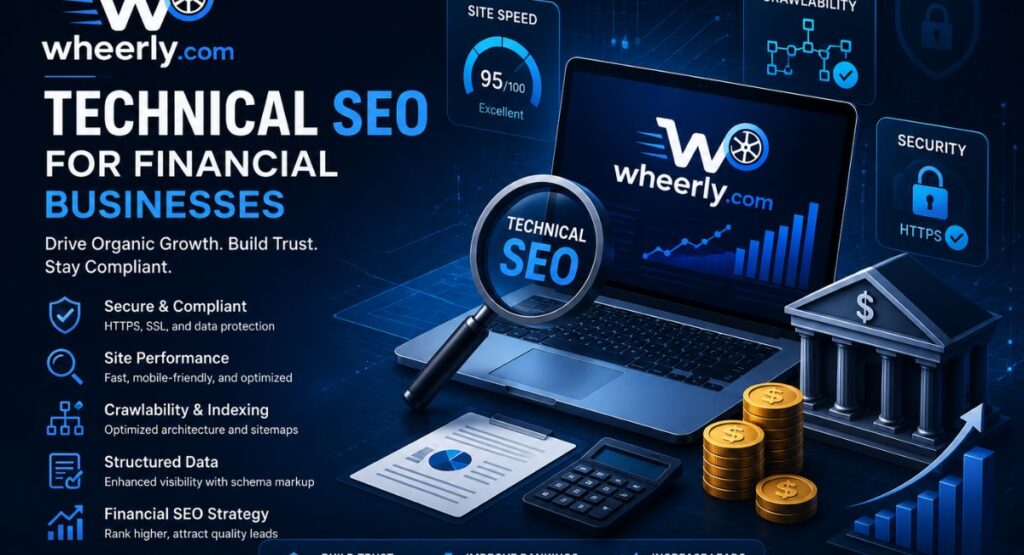

For financial businesses, organic search is not just about visibility—it is about credibility. Whether you operate a fintech startup, an investment consultancy, or a local accounting firm, ranking on Google requires passing the strictest quality checks. Google categorizes financial sites under YMYL (Your Money or Your Life), meaning your technical setup must be flawless to earn top rankings.
While creative content attracts users, Technical SEO ensures that search engine crawlers can find, index, and trust your platform. Let’s break down the critical technical optimizations required to scale a financial website safely and effectively.
1. Bulletproof Security and HTTPS Protocol

In the financial sector, security is the bedrock of trust. Google treats security as a primary ranking signal, especially for sites handling sensitive user transactions, bank details, or personal data.
- Advanced SSL/TLS Certificates: Moving from HTTP to HTTPS is basic. Financial firms should deploy Extended Validation (EV) SSL certificates to signal maximum encryption protocols to both users and search engines.
- HSTS Implementation: Enable HTTP Strict Transport Security (HSTS). This instructs browsers to only interact with your site using secure HTTPS connections, preventing malicious downgrade attacks.
- Data Privacy Compliance: Ensure your servers comply with regional laws (like GDPR or local banking regulations). A secure server environment prevents data leaks, protecting your site from legal penalties and sudden algorithmic demotions.
2. Optimizing Core Web Vitals for Financial Decisions

Financial decisions are time-sensitive. If a user tries to access a mortgage calculator or a live stock chart and the page lags, they will instantly bounce. Google measures this user experience through Core Web Vitals.
- Largest Contentful Paint (LCP): Your main page elements must load within 2.5 seconds. Optimize this by compressing heavy financial reports, utilizing next-gen image formats (WebP), and leveraging a Content Delivery Network (CDN).
- Interaction to Next Paint (INP): This tracks responsiveness. When a user inputs data into a loan calculator, the page must respond instantly. Minimize heavy JavaScript to ensure smooth interactive tools.
- Cumulative Layout Shift (CLS): Visual stability is critical. Financial charts or banners should never shift unexpectedly while a user is reading a fine-print disclosure. Always define explicit dimensions for your media and code elements.
3. Financial Schema Markup: Speaking Google’s Language

Search engines do not read data the way humans do. To help Google understand your specific financial products, you must implement Structured Data (Schema Markup). This converts plain text into rich snippets in search results.
- FinancialProduct Schema: Use this to explicitly define your interest rates, loan terms, and service fees directly to Google’s crawlers.
- InvestmentFund & InsuranceProduct Schema: If you offer specific portfolios or insurance policies, structured data allows Google to display your offerings cleanly, increasing your click-through rate (CTR).
- Organization Schema with Authoritativeness: Tie your corporate profiles, physical addresses, and official certifications together. This directly feeds into Google’s E-E-A-T (Experience, Expertise, Authoritativeness, Trustworthiness) framework.
4. Maximizing Your Crawl Budget

Large financial websites with thousands of product pages, blog posts, and dynamic calculators often waste their Crawl Budget—the number of pages Googlebot decides to scan on your site daily.
- Fixing Indexing Issues: Keep a sharp eye on your Google Search Console. Resolve errors like “Crawled – currently not indexed” by eliminating duplicate content or thin, low-value pages.
- Clean URL Structure: Avoid infinite URL parameters generated by dynamic search filters on your site. Use canonical tags to point Google to the definitive, master version of each page.
- Sitemap and Robots.txt Maintenance: Keep your XML sitemap updated and dynamically generated. Use your
robots.txtfile to block search bots from crawling secure client login portals or internal admin directories.
Frequently Asked Questions (FAQs)
Q1: Why is Technical SEO harder for financial websites compared to other niches?
Financial websites fall under Google’s YMYL (Your Money or Your Life) category. Google applies extremely high standards for accuracy, security, and technical stability because poor information or broken functionality can financially harm a user.
Q2: How does a slow page speed affect my financial site’s rankings?
A slow site directly triggers a high bounce rate. Since Google prioritizes user experience through Core Web Vitals, pages that take more than 3 seconds to load lose both user conversions and their algorithmic ranking positions.
Q3: What is the most important Schema template for an accounting or investment firm?
The FinancialProduct and LocalBusiness (or Organization) schemas are vital. They help Google verify your physical presence, official operating credentials, and display precise details like interest rates or consultation terms directly in search results.
Q4: Should I allow Googlebot to crawl my secure client dashboard?
No. You should use your robots.txt file to disallow crawling on any private client areas, login dashboards, or transaction histories. This protects user privacy and saves your valuable crawl budget for public, revenue-generating pages.
Q5: How often should I run a technical SEO audit on a financial platform?
A comprehensive technical audit should be conducted at least once every quarter. However, critical elements like site uptime, server errors, and broken redirect loops should be monitored continuously using automated tools.
Conclusion
Mastering technical SEO for financial businesses is all about eliminating friction for both search crawlers and human users. By securing your architecture with pristine HTTPS protocols, optimizing responsive financial calculators for Core Web Vitals, and implementing rich schema markup, you build a foundation of digital trust. In a niche governed by strict YMYL standards, a technically flawless website is your greatest competitive advantage to capturing sustainable organic market share.


Pingback: Technical SEO Audit Services: The Financial Enterprise Security & Growth Blueprint 2026 - wheerly