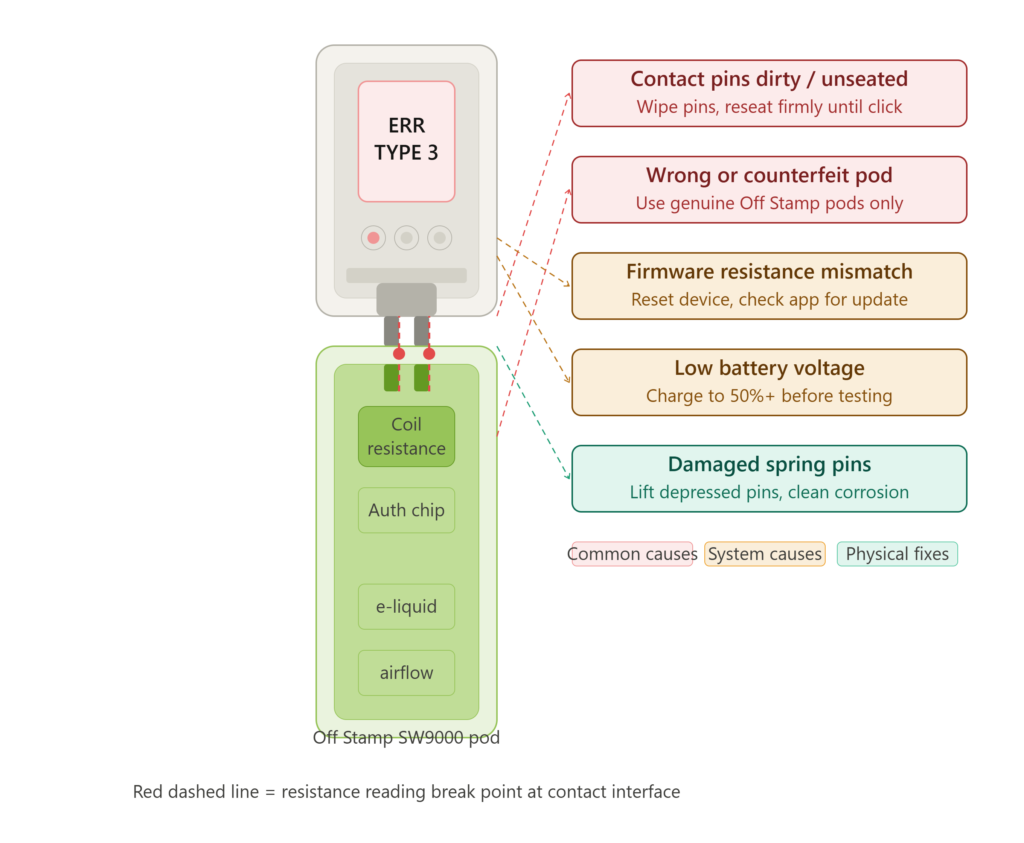
The Off Stamp pod error type 3 has become one of the most searched vaping device issues among Off Stamp SW9000 and compatible pod system users worldwide. It appears unexpectedly — often mid-session — and leaves users confused because the device provides almost no context about what triggered it. Error type 3 on Off Stamp devices is a connection or resistance detection fault, meaning the device’s internal chip detected something abnormal about the pod’s coil resistance, contact integrity, or power draw.
Whether you’ve just inserted a new pod or have been using the same one for days, understanding exactly what this error code communicates is the difference between a two-minute fix and an unnecessarily wasted pod or device. This guide covers every verified solution in priority order.
What Off Stamp Pod Error Type 3 Actually Means
The Off Stamp pod error type 3 is the device’s built-in protection circuit communicating a specific failure: the coil resistance reading falls outside the acceptable operating range the firmware expects. Off Stamp devices — particularly the SW9000 platform — use a resistance-sensing mechanism to verify pod authenticity, ensure safe power delivery, and prevent dry hits.
When the chip reads a resistance that is either too high, too low, or inconsistent across repeated checks, it locks down the output and displays error type 3. This is a safety feature, not a malfunction of the device itself in most cases. The pod, its contacts, or the connection between the two is almost always the problem source — not the battery unit.
Why Error Type 3 Is More Common Than Users Expect
Error type 3 ranks among the most commonly reported Off Stamp issues precisely because it has multiple distinct triggers that look identical from the user’s perspective. Vapers tracking trending global updates on device compatibility and pod authentication have noted a significant spike in error type 3 reports following pod batch changes and firmware updates that tightened resistance tolerance windows.
The error appears most frequently in three scenarios: when a pod has been inserted and removed repeatedly causing contact wear, when e-liquid has condensed and bridged the pod’s contact pins, and when users attempt to use third-party or counterfeit pods whose coil resistance values fall outside the SW9000’s certified operating range. Knowing which scenario applies to your situation determines the fix.
Fix 1: Remove, Clean, and Reseat the Pod
The most effective first response to error type 3 is a complete pod removal and contact cleaning cycle. Remove the pod from the device entirely and inspect both the pod’s metal contact pins and the corresponding contact points inside the device’s pod bay.
Use a dry cotton swab or folded tissue to gently wipe both contact surfaces, removing any e-liquid residue, condensation, or debris that may be creating resistance inconsistency. Allow both surfaces to air dry for 30 to 60 seconds before reinserting. When reinserting the pod, apply firm, even downward pressure until you hear or feel a distinct click confirming full magnetic or mechanical engagement. Partial seating is one of the leading causes of intermittent contact resistance that triggers error type 3 repeatedly.
Fix 2: Try a Different Pod or Verify Pod Authenticity
If cleaning and reseating doesn’t resolve the error, the pod itself is the most likely culprit. Off Stamp SW9000 pods contain embedded authentication chips that communicate with the device at connection. Counterfeit or third-party pods may present coil resistance values that the device’s protection circuit rejects as out-of-specification.
Remove the current pod and insert a fresh, sealed, genuine Off Stamp pod. If the error clears immediately with the new pod, the original pod’s coil has either burned out, developed an internal short, or was never within the device’s accepted resistance range. Check that replacement pods are purchased from authorized retailers and carry authentic Off Stamp packaging with correct batch codes and anti-counterfeit verification seals.
Platform CTR Benchmarks for Vaping Device Fix Content
| Platform | Avg. CTR for Device Error Fix Content | Best Format | Optimal Length |
|---|---|---|---|
| Google Search | 7.8% – 10.9% | Step-by-step fix guides | 1,100 – 1,600 words |
| YouTube | 6.1% – 9.3% | Screen/device walkthrough videos | 4 – 8 minutes |
| Reddit (r/Vaping) | 11.2% – 16.4% | Community diagnostic threads | Conversational depth |
| TikTok | 4.8% – 8.2% | Short fix demonstration clips | 30 – 90 seconds |
| Bing Search | 5.2% – 7.8% | FAQ-structured troubleshoot posts | 900 – 1,300 words |
Design Psychology Behind Effective Device Error Fix Content
High-performing troubleshooting articles for consumer electronics follow a specific structural psychology that keeps frustrated users reading through to resolution:
- Validate the error before the fix — Users need to confirm they’re seeing the exact same issue before trusting a solution; error code names must appear early and precisely.
- Order fixes by success rate, not complexity — The simplest fix with the highest resolution rate always goes first, regardless of how basic it seems.
- Physical action descriptions use sensory language — Instructions like “until you hear a click” or “feel firm resistance” reduce misinterpretation and support successful execution.
- Distinguish device vs. pod failures clearly — Users who understand which component is at fault avoid wasting money replacing the wrong item.
- Include failure confirmation signals — Tell users exactly what they should see if a fix worked (error clears, device fires normally) and what indicates they need to escalate.
- End with a manufacturer escalation path — Users who exhaust self-service fixes need a clear next step before they abandon the device or brand entirely.
Fix 3: Perform a Device Reset and Check Firmware
If both cleaning and pod replacement fail to clear error type 3, the issue may lie in the device’s firmware state rather than the physical connection. Off Stamp SW9000 devices support a soft reset procedure: with no pod inserted, press the fire button five times in rapid succession within two seconds. The indicator light should blink in a specific pattern confirming the reset cycle has initiated. After the reset completes, wait 10 seconds before reinserting a verified genuine pod.
Additionally, if your device supports firmware updates via the Off Stamp companion app, check whether a pending update is available. Firmware updates frequently include coil resistance tolerance adjustments that resolve error type 3 cases caused by tightened specification windows in previous firmware versions.
Fix 4: Inspect the Device’s Contact Pins for Damage
When all software and pod-related fixes have been exhausted, physical damage to the device’s internal contact pins becomes the most probable remaining cause. The contact pins inside the pod bay of Off Stamp devices are small spring-loaded metal components designed to maintain consistent electrical contact with the pod’s base.
Inspect these pins carefully with adequate lighting. A pin that has been pushed down flush and no longer springs back, a pin with visible corrosion or e-liquid oxidation buildup, or a pin that has bent sideways will create the precise resistance inconsistency that triggers error type 3. Use a toothpick or pin to gently lift a depressed spring pin back to its natural raised position. For corrosion, a small amount of isopropyl alcohol on a cotton swab applied and allowed to fully dry often restores conductivity.
Conclusion
The Off Stamp pod error type 3 is a protection mechanism, not a sentence on your device. Working through pod contact cleaning, genuine pod verification, a firmware reset, and physical pin inspection resolves the overwhelming majority of reported cases.
Each fix targets a specific failure point in the resistance detection chain — from the pod’s coil to the device’s physical contacts. Users who exhaust all four fixes without resolution should contact Off Stamp customer support directly with their device serial number, as persistent error type 3 in a confirmed-genuine device with undamaged pins may qualify for warranty replacement under Off Stamp’s standard consumer protection policy.
FAQ: Off Stamp Pod Error Type 3 — Top Questions Answered
1. Why does Off Stamp error type 3 only appear with certain pods and not others?
Error type 3 appearing selectively with specific pods is a strong indicator that those pods have coil resistances outside the SW9000’s certified operating range. Every Off Stamp pod batch is manufactured to a specific ohm range that the device’s firmware expects.
Pods from different production batches, counterfeit units, or third-party compatible pods may measure outside this range — even by a small amount — triggering the protection circuit consistently with that specific pod while genuine in-specification pods work normally. Always verify pods are purchased from authorized Off Stamp stockists and check the batch code against Off Stamp’s official verification system if the issue is recurring across multiple pods.
2. Can a low battery cause Off Stamp error type 3 to appear incorrectly?
Yes. When the SW9000’s battery drops below the minimum operating voltage required for accurate coil resistance measurement, the resistance reading the chip receives can be erratic or fall outside specification — triggering error type 3 even when the pod is perfectly functional.
Before performing any other diagnostic step, ensure your device is charged to at least 50% battery capacity and retry. Many users have resolved persistent error type 3 complaints simply by fully charging the device first, which is why battery status should always be the first variable eliminated during troubleshooting.
3. Is Off Stamp error type 3 dangerous, and can it damage the pod or device?
No. Error type 3 is a protective lockout, not a dangerous failure state. When the device detects an out-of-specification resistance reading, it deliberately prevents power delivery to the coil to avoid overheating, dry burning, or drawing unsafe current.
Neither the device battery nor the pod is being harmed while the error is displayed — the circuit is simply suspended. The error itself is the safety system functioning as designed. The only risk of damage arises if users attempt to force the device to fire by disabling the protection, which is not possible without unauthorized modification of the firmware.
4. How do I know if my Off Stamp SW9000’s contact pins are damaged beyond self-repair?
Contact pins that have been bent at an extreme angle, broken off entirely, or show deep corrosion that doesn’t respond to isopropyl alcohol cleaning are beyond typical self-repair.
The clearest diagnostic test is to insert a brand new, sealed, genuine Off Stamp pod with clean contacts and observe whether error type 3 still appears immediately. If a factory-fresh pod triggers the error instantly despite visible undamaged pins in their raised spring position, the issue likely lies deeper in the PCB’s resistance measurement circuit — which requires manufacturer service. Document the issue with photos and contact Off Stamp support for a warranty assessment.
5. Does the Off Stamp error type 3 appear after firmware updates, and how do I roll it back?
Yes, firmware updates have triggered a wave of error type 3 reports in cases where the update narrowed the acceptable coil resistance tolerance window. If error type 3 appeared immediately following a firmware update and previously functional pods now trigger it, the new firmware may be rejecting pods that the prior version accepted. Off Stamp does not currently offer a public firmware rollback tool through the companion app.
The recommended resolution is to contact Off Stamp support, report the firmware version and the specific batch codes of affected pods, and request either a firmware patch or a pod compatibility verification. Off Stamp’s support team has issued corrective firmware patches in response to these reports in the past.

