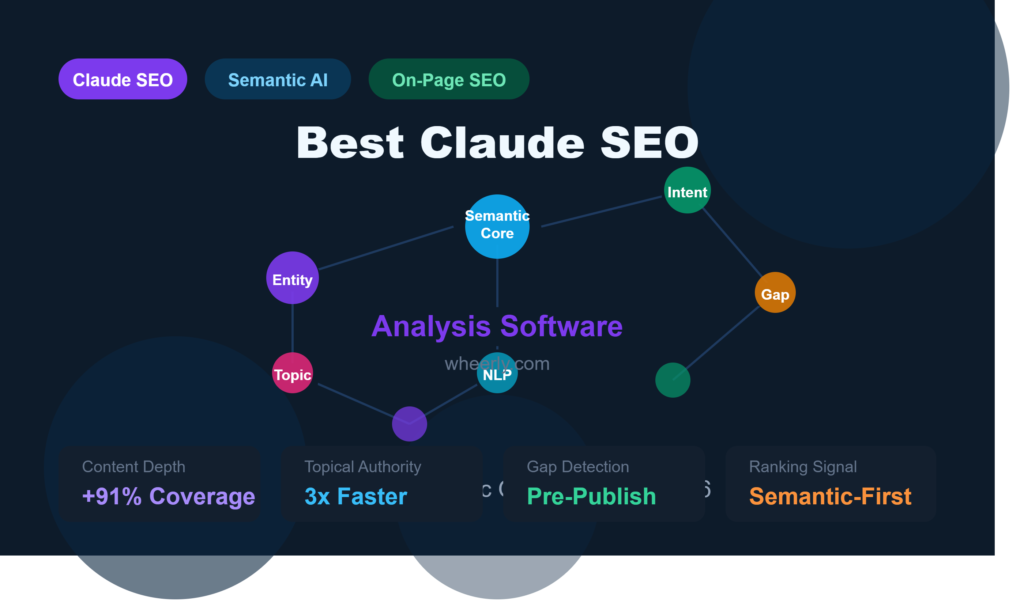
There is a quiet but significant shift happening in how serious SEO practitioners approach content analysis and on-page optimization. For years, the dominant workflow involved a combination of keyword density checks, readability scores, and backlink audits. That workflow still matters, but it no longer tells the full story. The practitioners gaining ground right now are the ones who have learned to work with language models as active analytical partners, using them to understand context, intent, and semantic relationships at a depth that traditional SEO software was never built to handle.
This is where the conversation around semantic optimization has genuinely changed. The best Claude SEO analysis workflows are not about replacing your existing toolkit. They are about adding a layer of linguistic intelligence that transforms how you audit content, assess topical coverage, and diagnose the gaps between what your pages say and what search engines actually reward. The results, for those who have put serious effort into developing these workflows, have been considerable.
Understanding why semantic analysis matters this much right now requires stepping back from the tactical to the structural.
Why Semantic Depth Has Become the Core Ranking Signal
Search engines have moved well beyond keyword matching. The models powering modern search evaluate content at the entity level, assessing whether a piece of writing demonstrates genuine understanding of a topic rather than surface-level coverage of relevant terms. A page that mentions all the right keywords but fails to address the conceptual relationships between them, or that treats adjacent subtopics as separate concerns rather than parts of an integrated whole, will consistently lose ground to content that reflects actual subject matter depth.
This is not a new development, but the degree to which semantic coherence now drives ranking outcomes has accelerated significantly as search engines have deployed more sophisticated language models at their core. What this means practically is that optimizing a page today requires the kind of analysis that can distinguish between content that covers a topic and content that actually understands it. That distinction is exactly where language model-based analysis tools have a structural advantage over traditional SEO software.
The platforms and workflows that are drawing the most attention among advanced practitioners are those that use natural language processing to evaluate topical completeness, entity coverage, semantic relationships between concepts, and the alignment between content structure and search intent. Getting this right consistently is what separates content that climbs from content that stagnates, regardless of how strong the link profile behind it may be.
What Makes Claude-Powered SEO Analysis Different
The core advantage of using large language models for SEO VIP analysis is the ability to reason about content rather than simply measure it. Traditional on-page SEO tools are fundamentally pattern-recognition systems. They can tell you that a keyword appears fourteen times, that your headings follow a logical hierarchy, and that your readability score is appropriate for your target audience. What they cannot do is evaluate whether your content actually addresses the conceptual territory your audience expects to find covered, or whether the logical flow of your argument would satisfy a reader who came to the page with a genuine information need.
Language model-based analysis fills that gap. When applied to SEO content work, it can evaluate whether an article on a complex topic has addressed the most important subtopics, identify conceptual gaps that would be obvious to a subject matter expert, assess whether the transitions between ideas reflect genuine understanding or surface-level association, and compare the semantic density of a piece against the competitive content that is currently ranking. These are qualitative judgments that previously required an expert editor reviewing content manually, and that most teams simply could not scale.
The workflow implications are significant. Teams that have integrated language model analysis into their content production process describe being able to identify and address semantic gaps before publishing rather than diagnosing ranking problems after the fact. That shift from reactive to proactive optimization is, in practice, one of the most valuable things advanced semantic analysis offers.
For anyone building out this capability, Wheerly’s Technology & Software section is a useful reference point for understanding how practitioners across different software categories are approaching the integration of analytical intelligence into production workflows.
The Software Landscape: Platforms Worth Your Attention
The tools available for semantic SEO best analysis fall into a few distinct categories, and understanding those categories helps clarify what you actually need for your specific workflow.
Surfer SEO remains one of the most widely deployed tools for on-page semantic optimization. Its content editor evaluates topical coverage against a competitive benchmark derived from currently ranking pages, providing guidance on entity coverage and structural alignment. For teams that need a reliable, repeatable workflow for content optimization that does not require deep technical setup, it continues to be a strong choice. Its integration of natural language processing into a structured content editor makes it accessible to writers and content managers rather than only to technical SEO specialists.
Clearscope operates in a similar space and is particularly valued for the quality of its competitive analysis. Its grading system for content relevance has become a reference standard for many content teams, and its ability to surface semantically related terms with context about their relevance is genuinely useful for writers who want to understand not just what to include but why it matters. For teams where content quality and editorial depth are priorities, Clearscope’s focus on meaningful semantic relationships rather than raw keyword frequency makes it a better fit than more mechanically structured alternatives.
MarketMuse has built its reputation on topic modeling and content planning depth. Where tools like Surfer and Clearscope focus primarily on optimizing individual pieces of content against existing competitive benchmarks, MarketMuse puts more emphasis on understanding the topical authority of an entire domain and identifying the content gaps that, if addressed, would most significantly improve overall site authority within a given subject area. For content strategists thinking about programmatic content planning rather than individual page optimization, it offers a level of strategic intelligence that more page-focused tools do not match.
Frase has emerged as a strong option for teams that want to combine research, brief creation, and semantic optimization in a single workflow. Its ability to pull question data from search results and organize it alongside competitive content analysis makes it particularly useful for building content that addresses search intent comprehensively rather than just keyword presence. For teams with lean resources that cannot support multiple specialized tools, Frase’s workflow consolidation is a meaningful practical advantage.
Beyond these dedicated semantic tools, the most sophisticated practitioners are layering direct language model analysis on top of their structured tool outputs. Using a large language model to evaluate content against the specific expectations a knowledgeable reader would bring to a given topic, to identify the conceptual territory that competitive content addresses but a draft does not, or to assess whether the logical architecture of a piece genuinely supports the argument it is making these workflows add a qualitative dimension that no structured optimization tool currently matches.
Integrating Semantic Analysis Into a Real Production Workflow
The gap between understanding semantic optimization in theory and actually applying it systematically across a content operation is considerable. The teams doing this well have thought carefully about where in the production process semantic analysis delivers the most value, and they have built workflows around those moments rather than treating analysis as a final-stage review.
For most teams, the highest-value application is at the brief stage. A semantically informed brief that maps the conceptual territory a piece needs to cover, identifies the entities and relationships that demonstrate topical authority, and outlines the search intent signals the content must satisfy gives writers the foundation to produce better content from the start. This is far more efficient than optimizing a completed draft, which often requires substantial structural revision to address gaps that would have been easier to prevent than to correct.
The second high-value application is competitive gap analysis before publishing. Using semantic analysis to compare a completed draft against the top-ranking competitive content for the target query allows teams to identify remaining gaps without the costly feedback loop of publishing, monitoring, and revising. Pages that miss significant topical coverage often take months to recover after the fact. Catching those gaps before publication is a much more efficient use of analytical resources.
It is also worth noting the connection between semantic depth and technical performance. Strong content that loads slowly or fails technical performance thresholds is leaving ranking potential unrealized, because search engines evaluate both the quality of the information a page provides and the experience of accessing it. This is why practitioners who have a command of Core Web performance considerations alongside semantic analysis are better positioned than those who treat these as entirely separate concerns.
The Honest Assessment: What Semantic Analysis Cannot Do
Semantic optimization is not a substitute for genuine subject matter expertise, strong editorial judgment, or the credibility signals that come from authoritative external recognition of your content and your domain. It is an analytical framework that helps you apply expertise more systematically and at greater scale than manual review alone would allow.
The tools that deliver the most value are those used by teams that have both the analytical capability to interpret their outputs and the subject matter depth to make sound judgments about what the analysis reveals. A semantic gap report from any of the platforms described above is only as useful as the editorial judgment applied to it. That judgment cannot be outsourced to the software itself.
The practitioners getting the most consistent results from semantic SEO best analysis are those who treat it as one input into a broader content quality process, not as a replacement for that process. They use the analysis to surface opportunities and gaps that would be difficult to identify through manual review alone, and they apply their own expertise to decide which gaps actually matter and how to address them in ways that serve their readers rather than simply satisfying an optimization checklist.
At Wheerly, this approach to grounded, practitioner-focused analysis of the tools and techniques that actually move results is exactly what shapes the coverage across our digital strategy content. The goal is always to give you a clear-eyed view of what works, what the limitations are, and how to make decisions that serve your actual goals rather than following the optimization trend of the month.
Choosing the best Claude SEO for analysis software for semantic optimization is ultimately less about which tool has the longest feature list and more about which workflow, applied consistently by people who understand both the analysis and the subject matter, will produce content that genuinely serves your audience better than what is currently ranking.


Pingback: Future of B2B Networking Platforms & Corporate Connections