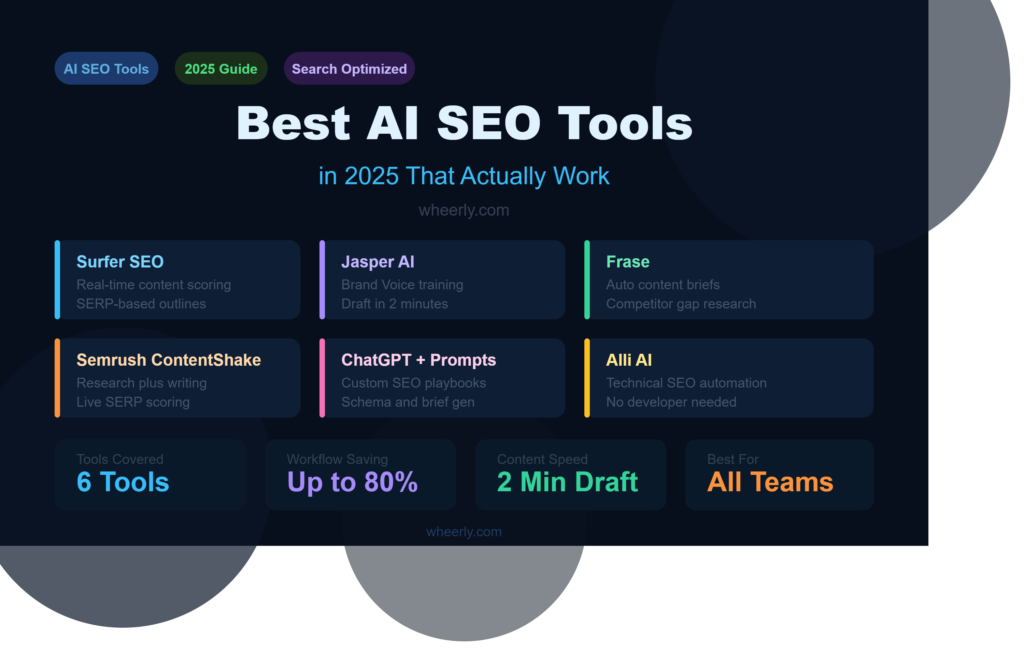
AI SEO tools have changed how marketers approach search optimization. Not slightly. Completely. The old process of manual keyword research, slow content audits, and guesswork-based on-page edits is giving way to something far more efficient. And the teams adopting these tools early are pulling ahead at a pace that is hard to ignore.
If you want to stay relevant in organic search, choosing the right AI SEO tools for your workflow is one of the most important decisions you will make this year. This guide covers the best options available in 2025, what each one actually does well, and how to match them to your specific needs.
Why AI SEO Tools Are No Longer Optional
Search engines are smarter than they were three years ago. They evaluate semantic relevance, entity authority, content depth, and user engagement signals all at once. Keeping up with that manually is practically impossible at scale.
AI SEO tools close that gap. They process data faster, identify patterns humans would miss, and execute repetitive optimization tasks in seconds. The result is a leaner workflow that produces better output with less effort. That is not a marketing claim. It is what the numbers show across thousands of content teams running these tools in production.
Surfer SEO: The Content Optimization Standard
Surfer SEO remains the benchmark for on-page content optimization among AI SEO tools. Its content editor grades your writing in real time against the top-ranking pages for your target keyword. It tells you which concepts your competitors are covering that you are missing.
The 2025 version added a stronger AI writing assist that generates content outlines based on live SERP data. Writers get a structured framework before they write a single word. For high-volume content teams, this reduces revision cycles significantly and keeps keyword density and semantic coverage on target from the first draft.
Jasper AI: Scaling Content Without Losing Brand Voice
Jasper is one of the most widely used AI SEO tools for content creation at scale. The feature that sets it apart in 2025 is Brand Voice training. You feed it your existing content, it learns your tone, and future outputs match your style rather than sounding like generic AI copy.
For enterprise teams managing multiple writers and content calendars, consistency has always been the hardest thing to maintain. Jasper solves that problem without replacing the humans on your team. It functions like a well-briefed writing assistant that never drifts off-brand and can produce a clean first draft in under two minutes.
Frase: The Research Layer Most Teams Skip
Most content teams underinvest in research. Frase fixes that. It is one of the few AI SEO tools that focuses specifically on the intelligence layer before writing begins.
Enter a keyword, and Frase pulls the top-ranking pages, summarizes the questions they answer, and builds a content brief automatically. Writers go into a draft knowing exactly what the competitive content covers and where the gaps are. According to Semrush’s content marketing research, content built around thorough competitive research consistently outperforms content written without it. Frase makes that research process fast enough to use on every single piece.
Semrush ContentShake AI: Research and Writing in One Place
Semrush added ContentShake AI to its platform and it fits naturally for teams already inside the Semrush ecosystem. This is where it gets interesting for anyone doing keyword research and content production in parallel.
ContentShake takes a keyword, generates a full draft, scores it against real SERP data, and suggests improvements before you publish. Having keyword research and AI content generation in one platform removes the friction of moving data between tools. For teams already paying for Semrush, this is a high-value addition at no extra cost on certain plans.
ChatGPT With Custom SEO Prompts
ChatGPT is not a dedicated SEO tool. But here is the catch: with the right prompts, it becomes one of the most versatile AI SEO tools in any workflow. The SEO community has spent two years refining prompt frameworks, and the output quality has improved significantly as a result.
Custom GPT models trained on specific SEO playbooks now generate content briefs, internal link recommendations, schema markup drafts, and competitor gap analysis in seconds. The tool is only as effective as the person using it. But experienced SEO practitioners are producing work at a speed that was simply not possible before these tools existed.
Alli AI: Technical SEO Without Developer Dependency
Most AI SEO tools focus on content. Alli AI focuses on the technical layer, and that distinction matters enormously for large sites.
Alli AI pushes title tag edits, meta description updates, schema additions, and internal link insertions directly to a live site without requiring developer time. For sites with thousands of pages, manual technical fixes are slow and expensive. Alli AI automates that work. Technical SEO debt that would take a developer team weeks to address can be resolved in a fraction of the time.
How to Pick the Right AI SEO Tools for Your Workflow
No single platform does everything perfectly. The most effective setups combine two or three AI SEO tools based on where the bottlenecks actually sit in your process.
Content volume and quality problems point toward Jasper or Surfer. Research depth and brief quality issues point toward Frase. Technical SEO backlogs point toward Alli AI. Teams already inside the Semrush ecosystem should explore ContentShake before adding a separate tool. Start with the problem, identify the gap, then pick the tool that closes it most efficiently.
The One Thing These Tools Cannot Replace
AI SEO tools amplify skill. They do not create it. A team with strong SEO fundamentals using these tools will see dramatic gains in efficiency and output quality. A team without those fundamentals will simply produce mediocre content faster.
The strategic layer, knowing which keywords matter, understanding search intent accurately, and reading algorithm signals correctly, still requires human judgment. These tools handle the execution. You still have to handle the thinking.

