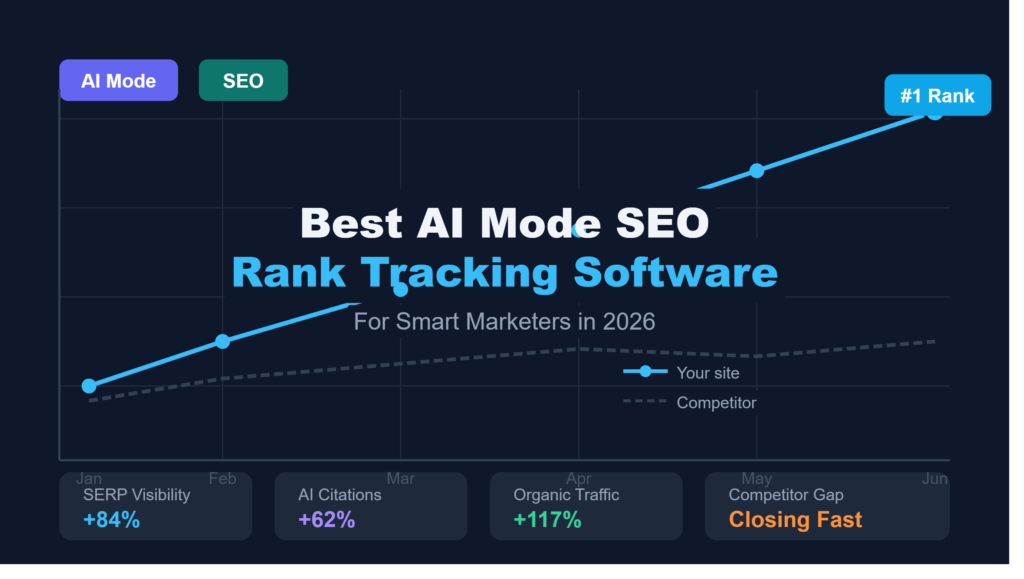
Search has changed more in the past two years than it did in the previous decade. The rise of AI-generated search results, conversational answer engines, and zero-click responses has pushed traditional rank tracking into uncomfortable territory. Tools built to monitor ten blue links are now facing a search landscape where those links are increasingly buried beneath AI Overviews, featured snippets, and conversational panels. If you are still relying on a rank tracker that only shows you a position number, you are operating with a blindfold on.
That is exactly why AI mode SEO rank tracking software has moved from a niche interest to a genuine strategic necessity.
Smart marketers are not just asking “where does my page rank?” anymore. They are asking whether their content appears in AI-generated summaries, whether their brand earns citations in conversational results, and how their organic visibility holds up as Google continues reshaping how it surfaces information. The tools built to answer those questions look very different from the ones that dominated the market five years ago.
Understanding what separates a capable rank tracker from one that is genuinely built for today’s search environment takes more than skimming a features list. It requires thinking clearly about what you actually need to measure, and why those measurements matter to your broader marketing goals.
Why Standard Rank Tracking Is No Longer Enough
Position tracking used to be simple. You entered a keyword, the tool returned a number, and you compared that number week over week. That model still has a role, but it captures an increasingly thin slice of search visibility. Google’s AI Overviews now appear above organic results for a significant share of informational queries, meaning that a page ranking in position one might still be receiving far less traffic than it did previously. A rank tracker that cannot account for that displacement is giving you numbers that feel meaningful but tell an incomplete story.
The situation becomes even more layered when you factor in the growth of platforms like Perplexity, ChatGPT Search, and Microsoft Copilot. A growing portion of users are finding information through these systems rather than through traditional search results pages. If your content is not structured, authoritative, and formatted in ways that make it citable by these systems, you are losing ground that no conventional rank tracker will ever show you.
For anyone serious about search performance today, the requirement is a platform that tracks traditional keyword positions alongside AI citation rates, featured snippet ownership, share of voice across search verticals, and competitor visibility within AI-generated answers. Wheerly’s Technology & Software coverage has been tracking this shift, and the consensus among practitioners is clear: the gap between basic rank trackers and AI-forward platforms is widening fast.
What the Best AI Mode Rank Tracking Platforms Actually Do
The most capable tools in this space share a few defining characteristics that set them apart from traditional trackers.
First, they monitor visibility across multiple search surfaces simultaneously. This means tracking not just page position in standard organic results, but also whether your content appears in AI Overviews, knowledge panels, People Also Ask boxes, and local packs. A single keyword can generate traffic from several of these surfaces at once, and a platform that only reports on one of them is giving you a distorted picture of your true organic footprint.
Second, the best platforms connect ranking data to actual traffic and engagement signals. Knowing that you rank in position four for a target keyword means very little if you cannot also see whether that position is driving sessions, and whether those sessions are converting. The most sophisticated tools integrate with analytics platforms to close that loop, so your rank data exists in context rather than isolation.
Third, and increasingly important, leading tools now offer some form of AI visibility monitoring. This means tracking whether your brand, content, or domain earns citations when users query conversational search platforms. Some tools have built dedicated modules for this; others fold it into their broader SERP monitoring features. Either way, this capability has moved from a novelty to a baseline expectation for serious SEO professionals in 2026.
Fourth, reliable competitor benchmarking remains non-negotiable. Knowing your own rankings without understanding how those rankings compare to your competitive set is like knowing your revenue without knowing your market share. The strongest platforms allow you to track competitor positions across every SERP feature, not just organic blue links, so you can identify opportunities where rivals are visible and you are not.
The Tools Earning Serious Attention in 2026
Semrush has remained one of the most comprehensive options available, and its recent investment in AI visibility tracking reflects where the market is heading. Its Position Tracking module handles traditional rank monitoring with considerable depth, while newer features attempt to surface how content performs within AI-generated results. The platform’s breadth is genuinely impressive, though that breadth comes with a learning curve that can slow down smaller teams.
Ahrefs continues to command strong loyalty, particularly among practitioners who value the quality and freshness of its backlink data alongside its rank tracking. Its keyword tracking interface is clean and its SERP feature monitoring has improved meaningfully over the past year. Ahrefs is perhaps best understood as an exceptional all-around SEO platform that includes strong rank tracking rather than a purpose-built rank monitoring tool.
Accuranker has built a reputation as one of the most reliable pure-play rank trackers on the market. It updates keyword positions daily, handles large keyword sets without performance degradation, and presents data in a way that makes reporting to clients or stakeholders relatively straightforward. For agencies managing multiple client accounts and needing reliable, granular position data at scale, it remains a strong choice.
Serpstat offers competitive pricing relative to its feature depth, which makes it particularly attractive for growing teams or businesses that need a capable platform without enterprise-level spend. Its rank tracking is solid, and its keyword clustering features are genuinely useful for content strategy work that sits alongside position monitoring.
BrightEdge and Conductor operate primarily in the enterprise segment. Both offer sophisticated tracking capabilities combined with content intelligence features and workflow tools that help large organizations align SEO activity with broader marketing operations. For teams at that scale, the added functionality justifies the investment. For smaller teams, the cost and complexity often do not.
Matching the Right Tool to Your Actual Situation
Choosing between these platforms is not simply a matter of picking the one with the longest feature list. The right choice depends on the scale of your keyword universe, how much competitor intelligence you need, whether AI visibility monitoring is a current priority or a future one, and how your team plans to use the data day-to-day.
For solo operators and small teams, a focused tool with clean reporting and daily updates will almost always outperform a complex enterprise platform that requires specialist knowledge to operate effectively. For agencies, client reporting quality and multi-account management capabilities matter as much as the underlying data. For in-house teams at larger companies, integration with analytics stacks, content management systems, and business intelligence tools often becomes the deciding factor.
It is also worth thinking carefully about your SERP feature exposure. If your content frequently appears in featured snippets or People Also Ask results, you need a tracker that monitors those features specifically, not just organic position. Similarly, if you operate in a space where local search matters, local pack tracking is non-negotiable rather than a nice-to-have.
One area that is easy to overlook but increasingly important is how your chosen platform handles page-level performance data in relation to technical health signals. Strong technical SEO and strong rankings are deeply connected, and just as Core Web performance metrics have become embedded in how Google evaluates pages, the best rank tracking platforms are beginning to surface technical signals alongside position data. A page that ranks well today but carries poor performance scores is a vulnerability that forward-thinking marketers want to see flagged proactively.
The Strategic Mindset Behind Smart Rank Tracking
No software, regardless of how sophisticated it becomes, replaces the judgment required to act meaningfully on the data it surfaces. The marketers getting the most value from advanced rank tracking tools are not those who check their dashboards most frequently. They are the ones who have defined clear success metrics before opening the platform, who understand the difference between a ranking movement caused by algorithm change versus content improvement versus competitor activity, and who connect position data to revenue outcomes their broader organization actually cares about.
This is the deeper skill that separates rank tracking as a tactical habit from rank tracking as a genuine strategic practice. When you understand why a ranking shifted, you can make informed decisions about what to do next. When you only know that it shifted, you are guessing.
The search landscape will continue evolving, and the tools used to measure performance within it will evolve alongside it. At Wheerly, the ongoing coverage of digital strategy reflects a belief that staying informed about how these changes affect your marketing decisions is not optional work. It is the foundation of sustainable performance in a search environment that rewards insight over instinct.
Choosing the right AI mode SEO rank tracking software is one of the more consequential decisions a marketing team makes. Get it right, and you gain a clear view of your competitive position across a search landscape that is more complex than it has ever been. Get it wrong, and you end up optimizing for a version of search that increasingly no longer exists.

