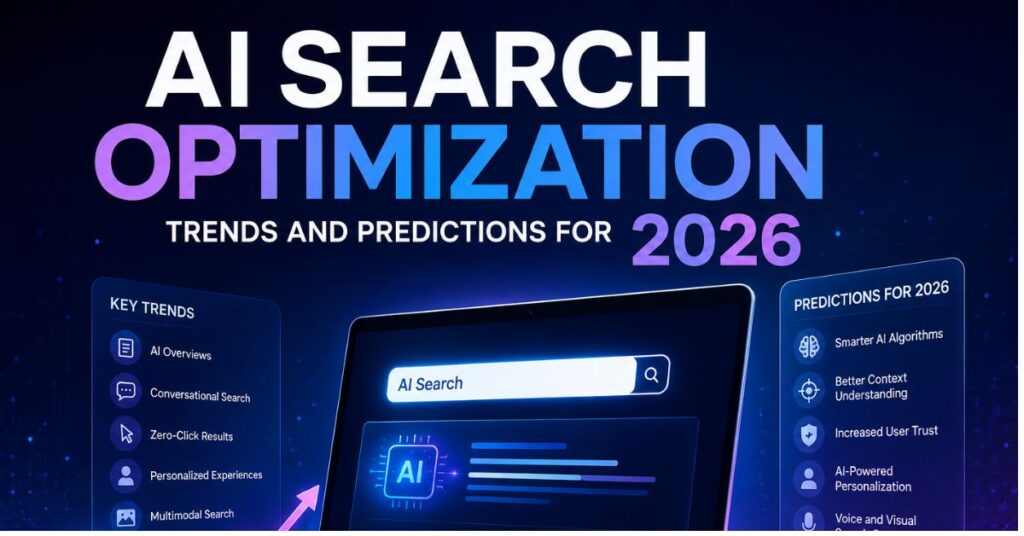
Search is no longer a single blue-links experience. In 2026, discovery happens across AI Overviews, chat-based assistants, and answer engines that read, synthesize, and cite content before a user ever clicks a traditional result. For brands and content creators, this shift means the rules of visibility have changed permanently, and businesses that fail to adapt risk disappearing from the discovery layer entirely.
This guide breaks down the most important AI search optimization trends shaping 2026, backed by observable shifts in how large language models retrieve, rank, and present information, along with practical steps you can take right now to stay visible.
Why AI Search Is Rewriting the Rules of Discovery
Traditional SEO was built around ranking pages in a list. AI search works differently. Instead of returning ten blue links, systems like Google AI Overviews, Perplexity, ChatGPT Search, and Claude-powered assistants generate a synthesized answer, often pulling from multiple sources simultaneously. That answer might cite your content, paraphrase it, or ignore it completely based on how clearly your information is structured and how trustworthy your domain appears to the model.
This is why marketers increasingly talk about Generative Engine Optimization (GEO) alongside traditional SEO. The two disciplines overlap heavily, but GEO adds a new layer of requirements focused on machine readability, source credibility, and answer-ready formatting. Wheerly’s own breakdown of this shift in AI Search Optimization and GEO offers a deeper look at how these two approaches fit together as one unified strategy.
Trend 1: Structured, Answer-First Content Wins
AI models favor content that answers a question directly within the first few sentences of a section. Long preambles, vague introductions, and buried conclusions are being systematically deprioritized because they slow down extraction.
What This Means for Writers
- Lead each section with a direct answer, then expand with supporting detail.
- Use descriptive H2 and H3 headings that mirror real user queries.
- Keep answer blocks between 40 and 80 words so they are easy for models to lift as standalone citations.
The Data Behind It
Multiple industry studies through 2025 tracked a consistent pattern: pages with clear, front-loaded answers were cited in AI Overviews significantly more often than pages using narrative-style introductions. This trend has only intensified heading into 2026, with answer-first formatting now considered a baseline requirement rather than a competitive advantage.
Trend 2: E-E-A-T Signals Are Now Machine-Verified
Google and other AI providers have moved beyond simple backlink counting to assess Experience, Expertise, Authoritativeness, and Trustworthiness using language models themselves. These systems evaluate author credibility, citation patterns, and content consistency across a domain.
Author Identity Matters More Than Ever
Byline transparency, visible author bios, and consistent topical authority across a site are now measurable ranking factors. Anonymous or thin-authored content is increasingly filtered out of AI-generated answers, especially in YMYL (Your Money or Your Life) categories like health and finance.
Building Topical Authority
Sites that publish deeply interconnected content clusters around a core topic, rather than scattered one-off posts, are rewarded with stronger AI visibility. A well-structured hub of related articles signals genuine subject-matter depth to both search crawlers and generative models.
Trend 3: Multimodal Retrieval Is Becoming Standard
By 2026, AI search systems are pulling from text, images, video transcripts, and structured data simultaneously to build answers. A page optimized only for text is leaving visibility on the table.
Practical Steps
- Add descriptive alt text and captions that reinforce the surrounding content’s meaning.
- Use schema markup (FAQ, HowTo, Article) to give models explicit structured signals.
- Include original images, charts, or diagrams rather than generic stock photography, since unique visual assets are more likely to be indexed and referenced.
Trend 4: Citation Frequency Is the New Ranking Signal
Instead of counting backlinks alone, AI search systems increasingly track how often a source is cited across multiple independent generative answers. Being referenced consistently by AI models is becoming a trust signal in its own right, feeding back into how future queries are answered.
How to Earn More AI Citations
- Publish original data, surveys, or first-hand findings that other sources will want to reference.
- Write clear, quotable statements that models can extract cleanly.
- Maintain factual accuracy and update content regularly, since outdated statistics are quickly deprioritized by retrieval systems.
Trend 5: Conversational and Long-Tail Queries Dominate
Voice assistants and chat-based search have normalized longer, more conversational queries. Instead of typing “best running shoes,” users now ask, “What are the best running shoes for flat feet and shin splints in 2026?”
Optimizing for Conversational Intent
Match Natural Language Patterns
Content should anticipate follow-up questions and address them in the same piece, reducing the need for a user to search again.
Build FAQ-Style Sections
Dedicated FAQ blocks formatted with schema markup remain one of the highest-performing formats for capturing long-tail, conversational queries inside AI-generated answers.
Trend 6: Site-Wide Technical Health Directly Impacts AI Crawlability
AI crawlers, including GPTBot, PerplexityBot, and Google-Extended, have specific crawling behaviors that differ from traditional search bots. Slow load times, blocked resources, and poor mobile rendering can prevent these crawlers from properly indexing content.
Technical Priorities for 2026
- Confirm robots.txt allows relevant AI crawlers where visibility is desired.
- Optimize Core Web Vitals, since AI crawlers deprioritize slow-loading pages during large-scale retrieval.
- Use clean, semantic HTML so models can parse content hierarchy without ambiguity.
Predictions: What to Expect Through the Rest of 2026
Looking ahead, several shifts appear increasingly likely based on current trajectories:
- AI Overviews will expand to more query types, including transactional and local searches, further compressing traditional organic click-through rates.
- Brand mention tracking will become a core KPI, as marketers shift focus from rankings alone to how often and how favorably their brand is mentioned across AI-generated answers.
- Retrieval-augmented generation (RAG) will tighten source vetting, rewarding domains with consistent publishing history and penalizing thin or newly created sites with limited trust signals.
- Hybrid search interfaces will become the norm, blending traditional results with AI-generated summaries on the same page, meaning both classic SEO and GEO tactics will remain necessary simultaneously.
How to Future-Proof Your Content Strategy
The businesses that adapt fastest will treat AI search optimization as an extension of good content practice rather than a separate discipline. That means prioritizing genuine expertise, structuring content for both human readers and machine extraction, and maintaining the technical health that allows AI crawlers to access and trust a site in the first place.
Explore Wheerly’s broader Technology & Software coverage for more tools and strategies designed to help publishers stay ahead of these shifts, and start with the foundational overview on Wheerly.com for a full picture of how GEO fits into a modern content strategy.
Conclusion
AI search optimization in 2026 is no longer optional. As generative engines take a larger share of how users discover information, the brands that win will be the ones that combine strong E-E-A-T fundamentals with content built specifically for machine readability. The shift from ranking pages to earning citations represents a fundamental change in how visibility works, and the strategies outlined above offer a practical roadmap for staying ahead of it.

