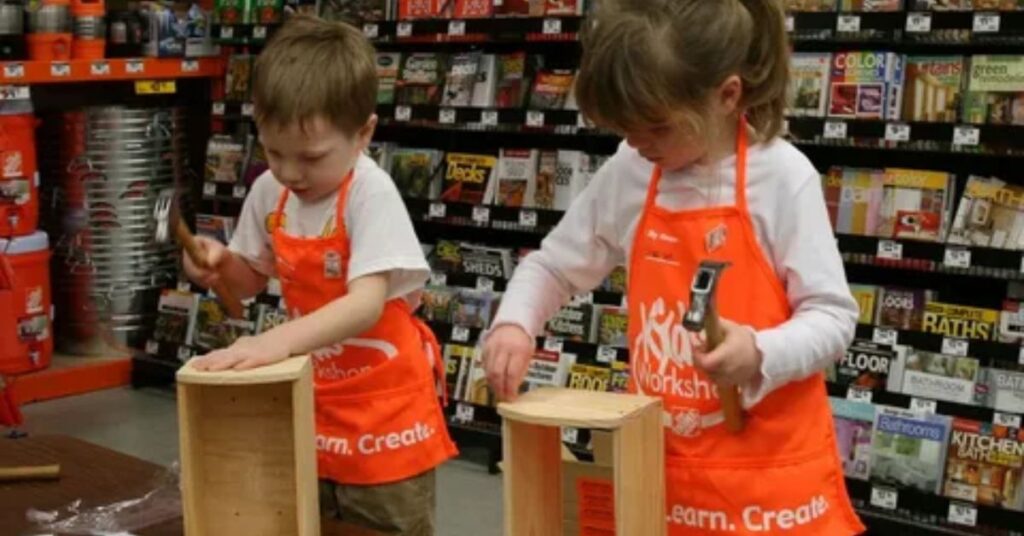
I used to think of the Home Depot Kids Workshop as a nice free Saturday activity and nothing more. It wasn’t until I watched my own kids work through a handful of builds, struggling with a step, correcting a mistake, figuring out how a piece fit, that I started noticing how much actual skill development was happening underneath the surface. This isn’t a classroom, but it teaches in ways a classroom often can’t.
Why Hands On Building Sticks With Kids
Kids remember things they physically do far longer than things they’re simply told. A thirty minute build at the workshop table involves reading instructions, measuring alignment by eye, using a tool correctly, and troubleshooting when something doesn’t quite fit the first time. That combination of steps is closer to real problem solving than most weekend activities offer.
Following Sequential Instructions
Every project comes with a printed instruction sheet, and kids have to work through it step by step rather than jumping around. This is a skill that transfers directly to schoolwork, recipes, and later on, more complex projects. Watching a seven year old pause, recheck the instructions, and correct a piece they placed wrong is a small but genuine exercise in self correction.
Fine Motor Skill Development
Hammering a nail straight, holding a screwdriver at the right angle, painting within the lines of a small surface, these all demand a level of hand control that younger kids are still developing. Repeated monthly visits give kids a low pressure way to build that control over time rather than in a single session.
Basic Tool Familiarity
A lot of kids simply haven’t held a real hammer or screwdriver before their first workshop. Learning what these tools do, how much force is actually needed, and how to use them safely under supervision is a practical life skill that doesn’t always come up naturally at home, especially for families without a dedicated workspace or garage setup.
The Confidence Factor
There’s a specific kind of pride that shows up when a kid finishes something they built themselves, distinct from finishing a coloring page or a puzzle. My daughter’s first go kart build wasn’t perfect. One wheel sat slightly crooked. But she noticed it, decided she didn’t care, and wore that apron around the store like she’d built a car from scratch. That reaction repeats itself almost every month across different families at different tables.
Ownership Over the Outcome
Because kids do the actual assembly themselves, with a parent stepping in only where needed, the finished project feels earned rather than handed to them. This matters more for kids who don’t get many chances to complete something visible and tangible on their own.
Handling Small Mistakes in Real Time
Not every piece goes together perfectly on the first try. A nail bends, paint smudges, a piece goes on backward. These are small, low stakes mistakes, and watching a kid work through frustration and fix it themselves, or ask for help and try again, builds a tolerance for imperfection that’s harder to teach directly.
Social and Cooperative Skills
The workshop table is a shared space with other families, not a private setup. Kids end up working near, and sometimes with, other children they’ve never met, which introduces a mild but useful social dimension to the activity.
Learning to Share Tools and Space
With limited hammers and paintbrushes at a shared table, kids often have to wait their turn or share supplies with a neighboring family. It’s a small, everyday version of cooperation that doesn’t feel like a lesson because nobody’s framing it that way.
Parent and Child Collaboration
For younger kids especially, the build becomes a genuine joint task rather than a parent doing something for a child. Handing over the hammer for the actual nail, then stepping back, is a small trust exercise that repeats every visit.
STEM Connections Beyond the Table
Home Depot partners with Discovery Education on Science Fair Central, offering free extension activities tied to several monthly builds. A finished planter from April’s build, for example, comes with printable instructions for actually planting something in it, turning a thirty minute craft into a week-long observation project about plant growth.
Practical Math in Action
Measuring, counting pieces, aligning holes, these are small but real applications of spatial reasoning and basic math that kids encounter without it being framed as a math lesson. For families looking for a way to reinforce these concepts outside of school, this kind of low pressure, hands-on practice fills a gap that worksheets often don’t.
Cause and Effect Through Functional Builds
Projects like the go kart or rocket game aren’t purely decorative. They move, they launch, they function. Kids see a direct cause and effect relationship between how they assembled something and whether it actually works, which is a more concrete lesson in mechanics than most kids encounter at this age.
Building a Long Term Habit Around Learning
The real value of the workshop compounds over repeated visits rather than showing up in a single session. A first timer might need heavy help with every step. By the sixth or seventh visit, that same kid is often working through the instructions with minimal input, correcting their own mistakes, and finishing well within the thirty minute window.
If you’re just getting started and want the full picture of what that first visit actually looks like before jumping into the learning side of things, the first visit guide walks through check in, the build process, and what to expect from start to finish.
Tracking Progress Over Time
Some families keep the pin-covered apron specifically as a visual record of how many builds a child has completed, which doubles as a small confidence marker over the course of a year. Community calendars and local event listings, including archived ones like this community event listing covering a past Home Depot Kids Workshop session, show just how long these events have been a fixture in local family routines, which speaks to how consistently valuable the format has proven over the years.
What This Means for Parents Weighing Their Options
Plenty of paid programs promise similar skill development, from woodworking classes to STEM kits sold online. The workshop offers a genuinely comparable experience at no cost, with the added benefit of being a recurring, low commitment routine rather than a multi week program requiring consistent scheduling.
It’s not a substitute for a full STEM curriculum, and nobody should treat it that way. But as a monthly touchpoint that builds fine motor skills, instruction following, and a small dose of hands on problem solving, it holds up better than most free activities available to families right now.
Final Thoughts
The Home Depot Kids Workshop works because it doesn’t try to teach anything explicitly. Kids show up expecting a fun craft, and the instruction following, tool handling, and problem solving happen almost by accident along the way. Over a year of monthly visits, that accidental learning adds up to something genuinely worth showing up for.


Pingback: Home Depot Kids Workshop Vs Lowe's: Which Free Program Wins In 2026