Search is not what it used to be. Not even close. The old way of dropping a keyword into a tool and watching your position number go up or down feels almost quaint now. Today, your audience is getting answers from AI engines. They are asking DeepSeek, not just Google. And if you are not tracking your visibility in those answers, you are essentially flying blind.
This is where a dedicated DeepSeek SEO rank tracking tool changes the equation entirely. It is not a gimmick. It is the natural next step for any serious marketer who wants to stay visible as search behavior shifts from clicking links to reading AI-generated responses.
What DeepSeek Actually Is (And Why It Matters for SEO)
DeepSeek launched its R1 model in January 2025 and immediately made noise. Built for a reported $5.58 million, it matched the performance of far more expensive Western models. It hit 100 million users faster than any AI tool in history. In several international markets, it briefly overtook ChatGPT in downloads.
That kind of adoption does not happen by accident. DeepSeek is fast, capable, and free at the basic level. People are using it daily to research products, compare services, and find answers. For marketers, that usage represents real traffic, real attention, and real buying intent.
The problem is that most SEO tools have not caught up. Platforms like Semrush, Ahrefs, and Moz still focus on Google, Bing, and increasingly Google’s AI Overviews. DeepSeek tracking? Most of them have not touched it. That gap is your opportunity.
Why Traditional Rank Tracking Falls Short Here
Here is the catch. DeepSeek does not return a list of ten blue links. It synthesizes a response and sometimes cites sources, sometimes mentions brands by name without links, and sometimes gives answers with no visible attribution at all. A first-paragraph citation in a DeepSeek response drives roughly five times more clicks than a footnote buried at the bottom.
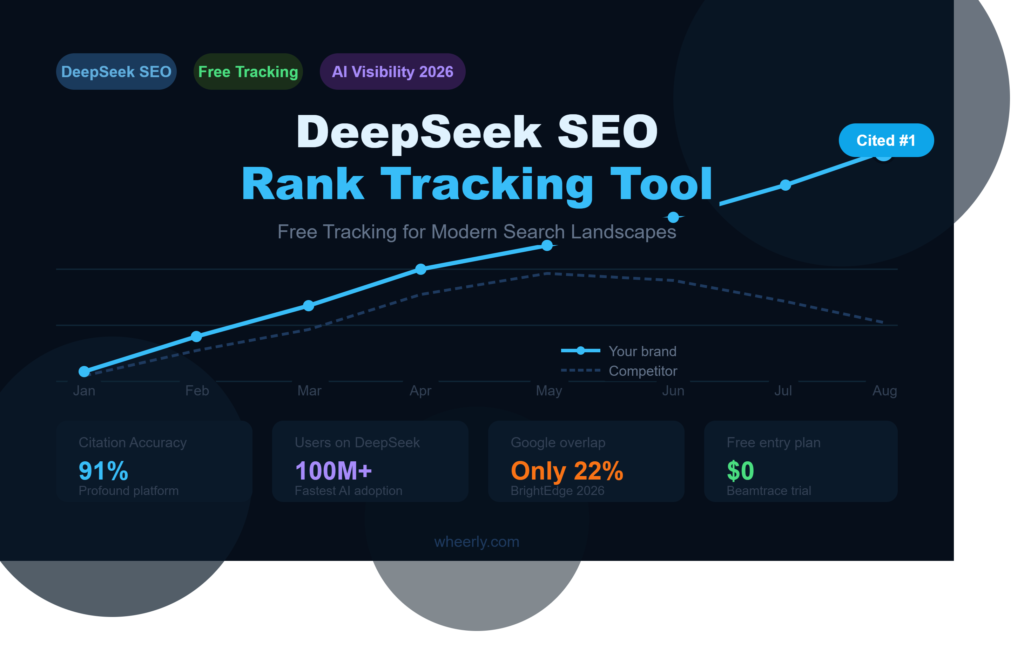
You cannot measure this with a standard rank tracker. Position one on Google does not translate directly to citation in DeepSeek. A BrightEdge analysis found that only 22% of Google’s top-ten results for commercial queries also appeared as cited sources in DeepSeek responses. That gap is startling. High Google rankings give you a foundation. But AI citation requires additional work on structured content, entity clarity, and answer-first formatting.
Traditional SEO tools simply were not built to parse whether your brand was mentioned with a link, without a link, or not at all. New platforms are. And that is precisely where modern tracking is heading.
The Free and Low-Cost Options Worth Knowing
Let’s face it, not every team has an enterprise budget. So where do you start without spending thousands a month?
Manual prompt testing is the simplest entry point. You build a structured spreadsheet, run target queries through DeepSeek manually, and log whether your brand appears, where it appears, and how it is described. It is time-consuming, but it costs nothing and gives you real baseline data to work with.
Beamtrace offers a 14-day free trial with full access, no credit card required. You plug in your website, and it shows where you appear in DeepSeek responses for key prompts, your positions, competitors showing up alongside you, and what to improve next. For smaller teams, this is a solid starting point before committing to a paid plan.
Cairrot is another option worth looking at, particularly if you run a WordPress site. It offers a free plugin that tracks when and how AI crawlers, including DeepSeek’s, explore your website. It covers over 20 LLM crawlers at no cost, which gives you useful signal data even on a tight budget.
RankScale uses a credit-based system starting around $20 per month for 120 credits. It is designed for teams that want to experiment with AI visibility tracking without locking into a large contract. Coverage spans seven-plus AI platforms, including DeepSeek and Mistral.
Enterprise Platforms Doing It at Scale
If you are managing multiple brands, client accounts, or high-stakes campaigns, the free tools will hit their ceiling quickly. This is where enterprise-level platforms earn their price.
Profound is currently the most comprehensive option on the market for multi-LLM tracking. It monitors citations across DeepSeek, ChatGPT, Perplexity, Gemini, Copilot, Grok, and others from a single dashboard. It scored a 91% citation accuracy rate in a 90-day internal test across 12 client accounts. Pricing starts around $99 per month for 100 tracked queries, with enterprise tiers scaling significantly from there.
According to HubSpot’s research on AI search adoption, over 70% of consumers now use AI tools for product discovery. That number is only growing. Platforms like Profound are built specifically to capture and quantify that visibility, not guess at it.
Rankability takes a slightly different approach. It connects directly to DeepSeek’s API rather than scraping, and it provides actionable diagnosis: not just whether you are cited, but why, and what specific on-page or entity changes would improve your citation rate. Weekly polling by default with daily options available.
What Good DeepSeek Visibility Actually Requires
Tracking is only half the job. The other half is understanding what makes DeepSeek cite you in the first place.
DeepSeek weights structured content heavily. It favors pages that give clear, direct answers to specific questions rather than broad thematic content. Entity recognition matters. If DeepSeek’s knowledge graph correctly associates your brand with your primary services, you appear. If it does not, you do not, regardless of how well you rank on Google.
Schema markup helps. Clean entity data helps. Getting cited on authoritative third-party sources helps even more. AI models learn who to trust by seeing who else trusts you. That is not so different from traditional SEO logic, but the execution looks different.
The Bottom Line
DeepSeek is not a trend to monitor from a distance. It is a live search channel with hundreds of millions of monthly queries and growing. If your brand is not visible in its responses, a portion of your audience is finding your competitors instead, and you have no idea it is happening.
Start with free tools if budget is a constraint. Use manual tracking as a baseline. Then move to a structured platform as your strategy matures. The marketers building DeepSeek visibility now are the ones who will own the citations when the rest of the industry finally catches up.
AI search visibility monitoring and brand citation tracking across large language models and next-generation search engines.

