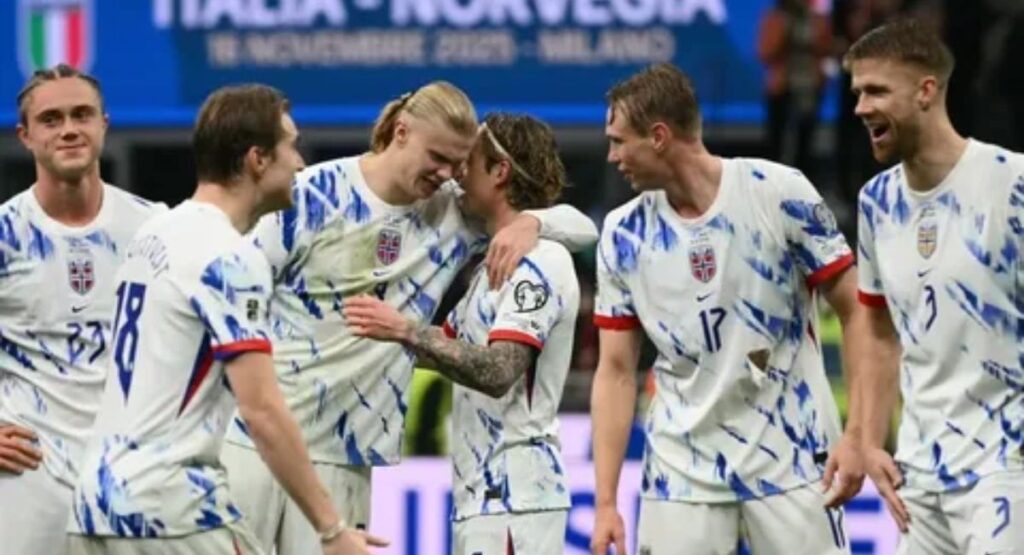
The norway world cup story is no longer a nostalgic tale of missed chances. It is a modern football narrative powered by elite talent, tactical maturity, and renewed belief. Norway are not just dreaming of the World Cup anymore—they are building toward it with intent.
For decades, Norway hovered on the edge of international relevance. Now, the landscape has shifted. A new generation has arrived, and with it, expectations that feel tangible rather than theoretical.

A New Era Begins for Norway on the Global Stage
The norway world cup ambition is fueled by a core group of players competing weekly at Europe’s highest level. This is not a rebuilding phase. It is a calculated ascent.
The spine of the squad blends physical dominance with technical intelligence. That balance is what separates hopeful qualifiers from genuine contenders.
Unlike previous cycles, Norway no longer relies on defensive resilience alone. They attack with structure, pace, and purpose.
The Tactical Identity Driving Norway Forward
Norway’s recent tactical evolution has been decisive. The team operates in a flexible system that shifts between compact defending and explosive transitions.
The emphasis is simple: win duels, release runners early, and punish defensive lines that hesitate.
This approach suits the squad’s strengths perfectly and has produced consistent results against higher-ranked opposition.
Star Power That Demands Respect
At the heart of the norway world cup conversation are two names that global defenders fear.
Erling Haaland provides raw scoring inevitability. His movement inside the box forces opponents to drop deeper than planned.
Martin Ødegaard controls tempo and direction. His passing breaks defensive lines before they fully organize.
Together, they give Norway something it has never truly had—world-class reliability in attack and creativity in midfield.
Home Advantage and the Importance of Momentum
Norway’s home fixtures play a crucial role in qualification campaigns. Matches at Ullevaal Stadion are intense, fast-paced, and emotionally charged.
Opponents struggle with Norway’s direct style in cold conditions. The crowd amplifies pressure, turning small tactical errors into match-defining moments.
Momentum at home often dictates whether Norway stays in contention deep into qualification cycles.
Key Match Insights and Historical Indicators
Norway’s progress toward the World Cup can be measured through clear performance indicators:
- Norway have increased their average goals per match in qualifiers over the last two cycles
- High pressing recoveries now lead directly to scoring opportunities
- Set-piece conversion rates rank among the strongest in their group
- Defensive errors have declined due to improved midfield shielding
- Norway’s expected goals (xG) metrics consistently outperform opponents at home
- The team shows stronger second-half performance due to superior physical conditioning
These data points reflect structural growth, not short-term form.
The Qualification Path and Competitive Landscape
The norway world cup journey is shaped by the unforgiving nature of European qualification. Groups are tight, margins are thin, and mistakes are punished instantly.
Norway now competes as an equal rather than an underdog. Their standing in FIFA World Rankings reflects steady upward movement.
Crucially, Norway has learned how to manage pressure games. That psychological shift often determines qualification success.
Why This Norway Feels Different
Previous Norwegian teams relied heavily on organization and spirit. This generation adds individual match-winners to that foundation.
There is also continuity in selection. Players understand roles, spacing, and transitional triggers.
This clarity reduces panic in decisive moments—something that historically undermined Norway’s campaigns.
Frequently Asked Questions
Has Norway ever qualified for the FIFA World Cup?
Yes, Norway previously qualified in 1938, 1994, and 1998, with their best run reaching the Round of 16.
Who is Norway’s most important player for World Cup qualification?
Erling Haaland is the primary goal threat, while Martin Ødegaard is the creative engine.
What is Norway’s biggest challenge in World Cup qualification?
Consistency against mid-tier European teams remains the toughest hurdle.
Conclusion: Norway’s World Cup Moment Is Approaching
The norway world cup narrative is no longer built on hope. It is built on structure, talent, and measurable growth.
Norway may not yet be favorites, but they are dangerous. They punish complacency, exploit space, and play with conviction.
If momentum holds and key players remain healthy, Norway’s return to the World Cup will not feel like a surprise. It will feel earned.

Pingback: mercury vs fever: WNBA Showdown Breakdown