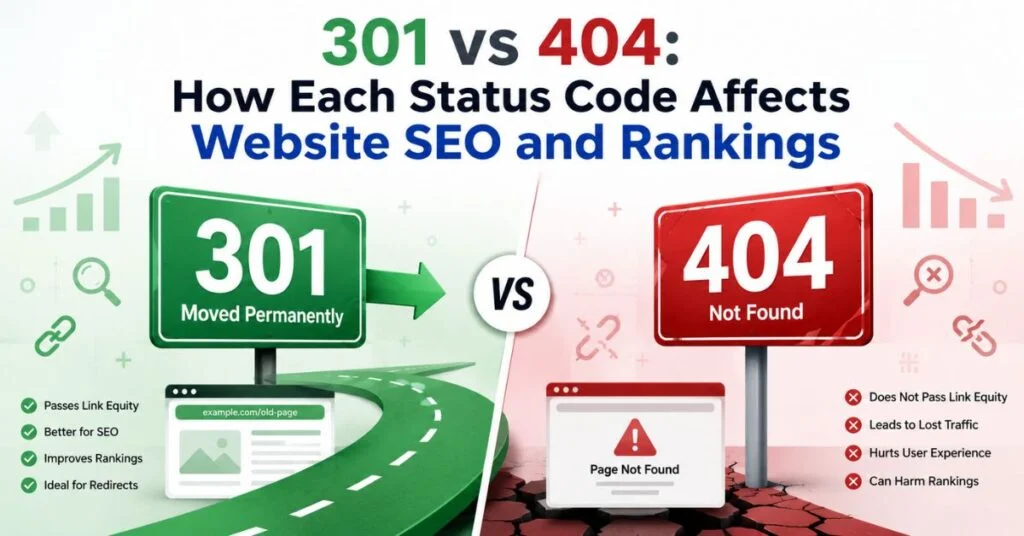
Status codes aren’t just technical housekeeping — they directly shape how much of your site’s ranking power survives a URL change. This article isolates the actual SEO mechanics behind 301s and 404s: what happens to link equity, crawl budget, indexing timelines, and keyword rankings when each code is deployed, so you can see the cause-and-effect rather than just the definitions.
The Ranking Mechanics Behind Each Code
How a 301 Affects Rankings
When Googlebot encounters a 301, it doesn’t rank the old and new URL separately — it consolidates them. Over successive crawls, PageRank-style link equity, topical relevance signals, and historical engagement data associated with the old URL begin transferring to the destination. This is why a well-executed migration with clean 301 mapping can preserve rankings almost entirely, while a sloppy one causes a visible traffic dip that only partially recovers.
HTTP/1.1 301 Moved Permanently
Location: https://example.com/new-page/
Google’s Search Central documentation confirms that 301s are treated as a strong signal for consolidating duplicate or moved content, and that the majority — not all — of ranking signals transfer, since factors like URL-specific engagement history don’t move with perfect fidelity.
How a 404 Affects Rankings
A 404 doesn’t just remove one page from search results — it severs every signal tied to that specific URL. Backlinks pointing to it stop passing equity anywhere. Keyword rankings that URL held vanish rather than transfer. If the page had strong topical authority contributing to the overall site’s category strength, that contribution erodes too.
HTTP/1.1 404 Not Found
Content-Type: text/html
This isn’t automatically harmful — if the content truly has no replacement, this is the accurate outcome. The damage only occurs when a valuable, backlinked page 404s without anyone checking whether a redirect should have been used instead.

Ranking Impact Comparison Table
| SEO Factor | Effect of 301 | Effect of 404 |
|---|---|---|
| Backlink equity | Transfers to new URL | Lost entirely |
| Keyword rankings | Migrate to destination URL over time | Disappear from search results |
| Crawl budget allocation | Google continues crawling the redirect chain briefly, then focuses on target | Google reduces crawl frequency, eventually stops visiting |
| Indexing timeline | New URL typically reflects consolidated signals within 2–4 weeks | Old URL removed from index within similar timeframe |
| Site-wide topical authority | Preserved through the destination page | Diminished if the 404’d page contributed meaningfully to a topic cluster |
| Traffic recovery pattern | Often near-full recovery if mapped correctly | No recovery unless content is later restored or redirected |
Crawl Budget: The Overlooked Ranking Factor
Large sites with thousands of URLs need to think about crawl budget as a finite resource. Excessive, unmanaged 404s waste Googlebot’s crawl allocation on dead ends, potentially slowing discovery of new or updated content elsewhere on the site. Redirect chains compound this problem — each additional hop in a chain consumes crawl budget without adding value, and Google has stated it may not follow chains beyond a handful of redirects. Flattening every redirect to a single hop directly to the final destination isn’t just cleaner, it’s a measurable crawl efficiency gain on larger sites.
Step-by-Step: Diagnosing Ranking Loss From Status Code Issues
- Check Google Search Console’s Page Indexing report for a spike in “Not Found (404)” entries that correlates with a traffic or ranking drop.
- Cross-reference the affected URLs against historical backlink data in Ahrefs or Semrush to identify which 404s represent real equity loss.
- Check for redirect chains using Screaming Frog’s redirect chain report — anything beyond one hop should be flattened.
- Verify redirect relevance — confirm every 301 target is topically equivalent to the source, not a generic fallback like the homepage.
- Re-implement missing redirects for any high-value 404s discovered, pointing directly to the most relevant live page.
- Track recovery in Search Console over the following weeks to confirm rankings and impressions begin returning to the consolidated URL.

Technical Takeaways
- Ranking signal loss from a 404 is not automatic damage — it only matters when the page had real backlink or ranking value.
- 301s transfer the majority, not all, of ranking signals, so expect near-full rather than guaranteed full recovery after migrations.
- Crawl budget is a real, measurable factor on larger sites, and redirect chains actively waste it.
- Site-wide topical authority can be affected by cumulative 404s across a content cluster, not just individual page rankings.
- Recovery timelines for both scenarios typically fall in the 2–4 week range for Google to reflect changes, though full stabilization can take longer.
Where This Fits Into Your Redirect Strategy
Understanding the ranking mechanics is essential, but applying it correctly across a full site requires a structured process. For the complete framework on redirect mapping, migration planning, and crawl budget preservation, see our comprehensive guide on 301 redirects and 404 error management.
FAQ
Q: Can a 404 error directly cause a drop in my site’s overall domain authority?
A: A single 404 rarely moves domain-level metrics, but a pattern of 404ing backlinked or high-ranking pages without redirects can measurably erode both authority and rankings over time.
Q: Do 301 redirects fully restore lost rankings after a migration?
A: Not always immediately, and not always to 100% of prior levels — most sites see the majority of rankings recover within a few weeks, with some fluctuation as Google re-evaluates the consolidated URL.
Q: How does crawl budget relate to 404 and 301 usage?
A: Excessive 404s and long redirect chains both waste crawl budget on non-productive requests, which can slow discovery of new or updated content on larger sites.
Q: Should I worry about a sudden increase in 404s reported in Search Console?
A: Yes, it’s worth investigating immediately — check whether the affected URLs held backlinks or rankings before deciding whether a redirect is needed.
Conclusion
301s and 404s don’t just describe a technical state — they actively determine what happens to your rankings. A 301 is a consolidation mechanism that preserves equity when used correctly; a 404 is a clean break that costs nothing if the content truly has no successor, but costs real rankings if it did. The sites that protect their SEO best are the ones that audit which code applies before defaulting to either one.

